If your bathroom stays damp after a shower, the problem may not be your tile, paint, or window. It may be your exhaust fan. I have seen this often. A fan that is too small can leave steam hanging in the room. Over time, that moisture can lead to peeling paint, ceiling stains, musty odors, and mold risk.
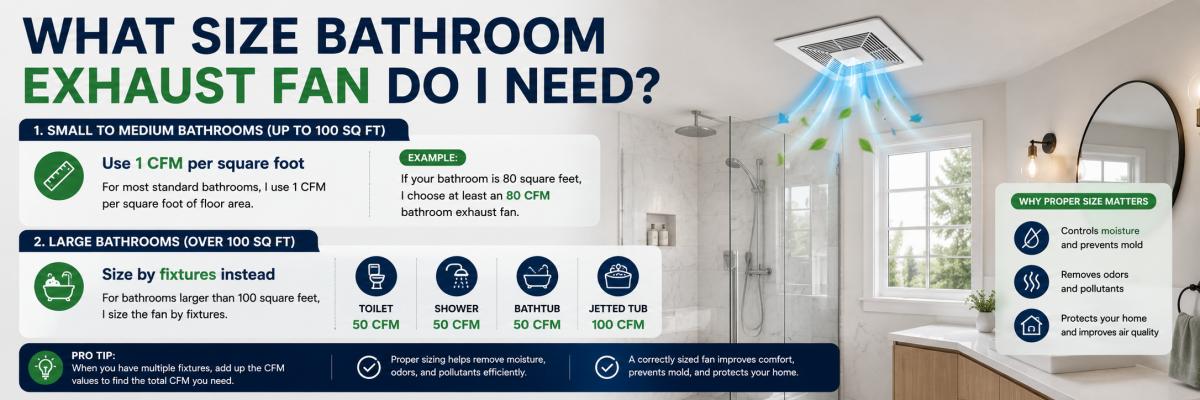
The quick answer: for most standard bathrooms, I use 1 CFM per square foot of floor area.
So, if your bathroom is 80 square feet, I would choose at least an 80 CFM bathroom exhaust fan. For bathrooms larger than 100 square feet, I size the fan by fixtures instead. I usually count 50 CFM for each toilet, shower, or bathtub, and 100 CFM for a jetted tub.
I’ll walk you through the exact method I use. Short. Clear. Practical.
Quick Answer: Bathroom Exhaust Fan Size Chart
For most bathrooms under 100 square feet, I use this simple rule:
Bathroom fan size = bathroom square footage × 1 CFM
Here is the basic chart I use.
| Bathroom Floor Area | Minimum Fan Size I Recommend | Simple Sizing Rule |
|---|---|---|
| 40 sq. ft. | 40 CFM | 1 CFM per sq. ft. |
| 50 sq. ft. | 50 CFM | 1 CFM per sq. ft. |
| 60 sq. ft. | 60 CFM | 1 CFM per sq. ft. |
| 70 sq. ft. | 70 CFM | 1 CFM per sq. ft. |
| 80 sq. ft. | 80 CFM | 1 CFM per sq. ft. |
| 90 sq. ft. | 90 CFM | 1 CFM per sq. ft. |
| 100 sq. ft. | 100 CFM | 1 CFM per sq. ft. |
For product efficiency and fan performance standards, I also like checking reliable resources such as ENERGY STAR Ventilating Fans and the Home Ventilating Institute.
What Does CFM Mean?
CFM means cubic feet per minute.
It tells us how much air the fan can move in one minute.
A 50 CFM fan moves 50 cubic feet of air per minute.
A 100 CFM fan moves 100 cubic feet of air per minute.
This number matters because bathrooms create moisture fast.
A hot shower can fill the air with steam in minutes. If the fan cannot move enough air, that moisture stays on the mirror, ceiling, walls, cabinets, and trim.
That is why I always size a bathroom fan by CFM first.
Not by looks.
Not by cover size.
Not by guesswork.

How Do I Calculate Bathroom Exhaust Fan Size?
I use a simple three-step process.
Step 1: Measure the bathroom
Measure the room length.
Then measure the room width.
Step 2: Multiply length by width
For example:
8 ft × 10 ft = 80 sq. ft.
Step 3: Match square footage to CFM
For an 80 sq. ft. bathroom, I choose at least an 80 CFM fan.
If the fan size falls between two common fan ratings, I choose the next size up.
For example:
- 55 sq. ft. bathroom → I choose 60 CFM
- 75 sq. ft. bathroom → I choose 80 CFM
- 95 sq. ft. bathroom → I choose 100 CFM
I do not undersize the fan.
That is one of my biggest rules.
What Size Bathroom Fan Do I Need for a Small Bathroom?
For a small bathroom, I still use 1 CFM per square foot.
A small bathroom is often around 40 to 60 square feet.
So the fan usually needs to be around 40 to 60 CFM.
But I pay close attention to whether the bathroom has a shower.
A small bathroom with a shower can get humid very quickly.
So, if the bathroom is 50 square feet, I choose at least 50 CFM.
If the bathroom is 55 square feet, I choose 60 CFM.
That small step up can help the fan remove moisture faster.
What Size Exhaust Fan Do I Need for an 80 Square Foot Bathroom?
For an 80 square foot bathroom, I recommend at least an 80 CFM exhaust fan.
This is one of the most common bathroom sizes.
It may include:
- A toilet
- A sink
- A shower
- A bathtub
The math is simple:
80 sq. ft. = 80 CFM minimum
But I may choose 90 CFM or 100 CFM if the duct run is long.
I may also size up if the duct has several bends.
Why?
Because duct resistance can reduce real airflow.
A fan rated at 80 CFM may not move the full 80 CFM if the duct path is poorly designed.
So I always look beyond the room size.

How Do I Size a Fan for a Large Bathroom?
For bathrooms over 100 square feet, I use the fixture method.
Large bathrooms usually have more moisture sources.
So I count each major fixture.
| Bathroom Fixture | CFM I Add |
|---|---|
| Toilet | 50 CFM |
| Shower | 50 CFM |
| Bathtub | 50 CFM |
| Jetted tub | 100 CFM |
Here is how I use it.
If a large bathroom has:
- 1 toilet
- 1 shower
- 1 bathtub
I add:
50 + 50 + 50 = 150 CFM
So I would choose at least a 150 CFM fan.
If the bathroom has:
- 1 toilet
- 1 shower
- 1 jetted tub
I add:
50 + 50 + 100 = 200 CFM
So I would choose at least a 200 CFM fan.
This fixture-based method is useful because large bathrooms do not always follow the simple square-foot rule well.
Should I Choose a Bigger Bathroom Fan?
Yes, sometimes.
If I am unsure, I usually choose the next size up.
But I do not go too far.
There is a big difference between sensible upsizing and oversizing.
For example:
- If I need 80 CFM, I may choose 90 or 100 CFM
- If I need 100 CFM, I may choose 110 CFM
- If I need 50 CFM, I do not jump to 200 CFM without a reason
Slightly bigger is usually better than too small.
But extremely oversized fans can be louder.
They may also pull air too aggressively.
My goal is balance.
Enough airflow.
Reasonable noise.
Good efficiency.

Why Is an Undersized Bathroom Fan a Problem?
An undersized fan is one of the most common bathroom ventilation mistakes I see.
It may run.
It may make noise.
But it may not remove enough moisture.
That creates long-term problems.
Common signs include:
- Foggy mirrors that stay wet
- Peeling paint
- Water stains on the ceiling
- Musty smells
- Damp drywall
- Mold or mildew risk
- Swollen wood trim or cabinets
Moisture control matters. The EPA explains that controlling moisture is one of the key steps in preventing mold growth. You can read more from the EPA mold and moisture guide.
That is why I never treat bathroom fan sizing as a small detail.
It protects the room.
It protects indoor air.
It protects the finish materials.
Does Ceiling Height Change the Fan Size?
Yes, ceiling height can matter.
The 1 CFM per square foot rule works best for bathrooms with standard ceilings.
If the bathroom has a tall ceiling, the room has more air volume.
More air volume means the fan has more air to move.
So if a bathroom is 80 square feet but has a high ceiling, I may choose 90 or 100 CFM instead of 80 CFM.
I keep this practical.
I do not overcomplicate it.
But I do use ceiling height as a reason to avoid choosing the smallest possible fan.

Do Duct Length and Duct Bends Matter?
Yes. A lot.
The fan does not just pull air from the bathroom.
It must push that air through ductwork and exhaust it outdoors.
A short, straight duct is best.
A long duct is harder.
A duct with many bends is even harder.
Each bend adds resistance.
That means the fan may move less air than its rating suggests.
So, if the bathroom calculation says 70 CFM, but the duct is long or has several elbows, I may choose 80 or 90 CFM.
I also make sure the fan vents outdoors.
Not into an attic.
Not into a wall cavity.
Not into a ceiling space.
Moist air must leave the home.
For general ventilation best practices, I recommend reviewing resources from the Home Ventilating Institute and ENERGY STAR.
How Much Does Noise Matter?
Noise matters more than many people think.
A loud fan often gets turned off too soon.
Or worse, people stop using it.
That defeats the purpose.
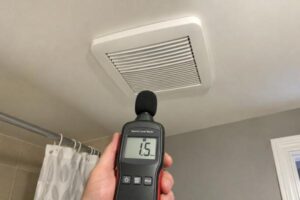
Bathroom fan noise is often measured in sones.
A lower sone rating means a quieter fan.
When I choose a fan, I look for:
- Correct CFM
- Low noise rating
- Good energy efficiency
- Reliable brand or certification
I choose airflow first.
Then I choose the quietest option in that airflow range.
A quiet fan is more likely to be used every day.
And a fan that gets used is the one that actually protects the bathroom.
Should I Look for an ENERGY STAR Bathroom Fan?
Yes, I usually do.
An ENERGY STAR certified fan can help reduce energy use while still moving air effectively.
This matters because bathroom fans may run every day.
Some people run them during showers.
Others run them for 15 to 30 minutes afterward.
That adds up.
I want a fan that is:
- Properly sized
- Efficient
- Quiet
- Strong enough for the duct layout
How Long Should I Run the Bathroom Fan?
Sizing is only part of the solution.
The fan also needs enough run time.
I usually recommend running the fan during the shower and after the shower.
A common practical range is 15 to 30 minutes after bathing.
This helps clear leftover humidity.
A timer switch can help.
I like timer switches because they remove the guesswork.
You turn on the fan.
The timer shuts it off later.
Simple.
Effective.

My Bathroom Exhaust Fan Sizing Process
Here is the process I use from start to finish.
- Measure the bathroom floor area
- Use 1 CFM per square foot for bathrooms up to 100 sq. ft.
- Use fixture-based sizing for bathrooms over 100 sq. ft.
- Check ceiling height
- Check duct length
- Check duct bends
- Choose the next size up if conditions are not ideal
- Compare noise rating
- Consider ENERGY STAR certified models
- Make sure the fan vents outdoors
This process keeps the decision clear.
It also makes the fan more likely to perform well in real conditions.
Common Bathroom Fan Size Examples
Here are a few real-world examples.
| Bathroom Example | My Calculation | Fan Size I Would Choose |
|---|---|---|
| 5 ft × 8 ft powder room | 40 sq. ft. | 40 to 50 CFM |
| 6 ft × 10 ft bathroom | 60 sq. ft. | 60 CFM |
| 8 ft × 10 ft bathroom | 80 sq. ft. | 80 to 100 CFM |
| 10 ft × 10 ft bathroom | 100 sq. ft. | 100 CFM |
| Large bath with toilet, shower, tub | 50 + 50 + 50 | 150 CFM |
| Large bath with toilet, shower, jetted tub | 50 + 50 + 100 | 200 CFM |
This is the kind of simple sizing table I use when I want a fast, reliable answer.
More Related Questions
Is 50 CFM enough for a bathroom?
50 CFM is enough for a bathroom around 50 square feet.
If the bathroom is larger, I would not use a 50 CFM fan.
If the bathroom has a shower and heavy steam, I may choose the next size up.
Is 80 CFM enough for a bathroom?
80 CFM is usually enough for an 80 square foot bathroom.
If the duct run is long or has several bends, I may choose 90 or 100 CFM.
Is 110 CFM too much for a small bathroom?
It depends on the bathroom.
For a very small bathroom, 110 CFM may be more than needed.
But for a medium bathroom with duct resistance, it may be reasonable.
I always calculate first.
What size fan do I need for a bathroom with a shower?
For a standard bathroom with a shower, I still start with 1 CFM per square foot.
For a large bathroom, I count the shower as 50 CFM.
Can a bathroom exhaust fan be too powerful?
Yes.
A fan can be too powerful if it is much larger than the room needs.
It may be louder.
It may waste energy.
It may feel uncomfortable.
But being slightly oversized is usually better than being undersized.
Conclusion
For most bathrooms, I choose 1 CFM per square foot. For bathrooms over 100 square feet, I size by fixtures. I also check ceiling height, duct length, noise, and efficiency. If I am unsure, I choose the next size up. I never undersize a bathroom exhaust fan.