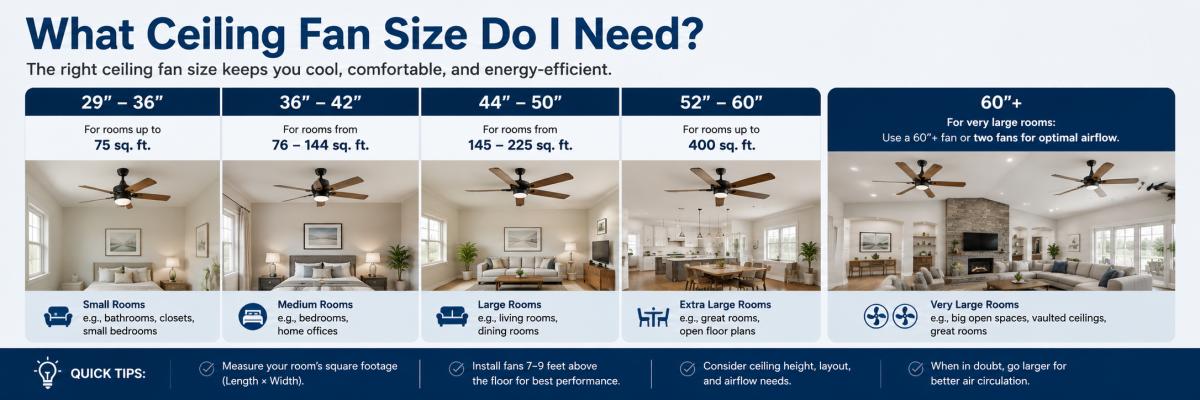
Choosing the wrong ceiling fan size is one of the fastest ways to make a room feel uncomfortable. I have seen small fans spin at full speed and still fail to move enough air. I have also seen oversized fans make small rooms feel crowded, noisy, and visually heavy. The problem is not the fan itself. The problem is usually poor sizing. Once I measure the room, check the ceiling height, and match the blade span correctly, the choice becomes much easier.
The ceiling fan size you need depends mainly on your room’s square footage. As a simple rule, I recommend a 29–36 inch fan for rooms up to 75 sq. ft., a 36–42 inch fan for rooms from 76–144 sq. ft., a 44–50 inch fan for rooms from 145–225 sq. ft., and a 52–60 inch fan for rooms up to 400 sq. ft. For very large rooms, I usually choose a 60+ inch fan or use two fans.
I do not choose ceiling fans by style first. I choose them by room size, ceiling height, clearance, and airflow needs. Then I look at finishes, lights, and controls.
──────────────────────────────────────────────────
Quick Answer: Ceiling Fan Size Chart
Here is the sizing table I use when I want a fast answer.
| Room Size | Common Room Type | Recommended Fan Size |
| Up to 75 sq. ft. | Small office, laundry room, small bedroom | 29–36 inches |
| 76–144 sq. ft. | Standard bedroom, kitchen, dining nook | 36–42 inches |
| 145–225 sq. ft. | Large bedroom, medium living room | 44–50 inches |
| 225–400 sq. ft. | Large living room, primary bedroom, open room | 52–60 inches |
| Over 400 sq. ft. | Great room, open-plan area, long patio | 60+ inches or multiple fans |

How Do I Measure a Room for a Ceiling Fan?
I always start with the same simple formula.
Room length × room width = room square footage
For example:
- 10 ft × 10 ft = 100 sq. ft.
- 12 ft × 12 ft = 144 sq. ft.
- 15 ft × 15 ft = 225 sq. ft.
- 20 ft × 20 ft = 400 sq. ft.
Once I know the square footage, I match it to the fan’s blade span.
Blade span means the full width of the fan from one blade tip to the opposite blade tip.
If the fan has an even number of blades, I measure from blade tip to blade tip.
If the fan has an odd number of blades, I measure from the center of the fan to one blade tip, then double that number.
That gives me the fan size.
──────────────────────────────────────────────────
Why Ceiling Fan Size Matters
Ceiling fan size matters because it affects air movement, comfort, noise, and room balance.
A fan that is too small may look fine, but it will not move enough air.
That means the room can still feel warm or stale.
A fan that is too large may move too much air.
That can create a drafty feeling.
It can also make the ceiling look crowded.
I want the fan to do three things:
- Move air evenly
- Fit the scale of the room
- Run comfortably without needing high speed all the time
A correctly sized fan can often run on low or medium speed.
That usually feels better.
It is also quieter.
The U.S. Department of Energy notes that fans can help improve comfort and reduce the need for air conditioning when used properly. I recommend reading the DOE’s guide on fans for cooling if you want more background on how fans support home comfort.

What Size Ceiling Fan Do I Need for a Bedroom?
For bedrooms, I usually recommend 36 to 52 inches, depending on the room size.
A small bedroom does not need a huge fan.
A large primary bedroom usually does.
Here is how I usually size bedroom fans:
| Bedroom Size | Square Footage | Fan Size I Recommend |
| Small bedroom | Under 100 sq. ft. | 36 inches |
| Standard bedroom | 100–144 sq. ft. | 42 inches |
| Large bedroom | 145–225 sq. ft. | 44–52 inches |
| Primary bedroom | Over 225 sq. ft. | 52–60 inches |
In bedrooms, I care a lot about quiet operation.
If the fan is too small, you may need to run it on high speed.
That can be annoying at night.
A better-sized fan can move air gently at a lower speed.
That is what I prefer.
For a bedroom with a low ceiling, I usually choose a flush mount ceiling fan.
For a bedroom with a standard 8 or 9 ft ceiling, I usually use a standard mount or a short downrod.

What Size Ceiling Fan Do I Need for a Living Room?
Living rooms usually need larger fans.
For many living rooms, I recommend a 52 inch ceiling fan.
For bigger rooms, I may choose 56, 60, or even 72 inches.
It depends on the shape of the room.
A square room is easier.
A long room is different.
If the living room is long and narrow, one large fan may not cover both ends well.
In that case, I may recommend two smaller fans instead of one oversized fan.
Here is my practical guide:
- 12 ft × 12 ft living room:42–52 inch fan
- 15 ft × 15 ft living room:52 inch fan
- 18 ft × 20 ft living room:56–60 inch fan
- Large open living room:60+ inch fan or two fans
I also think about where people sit.
A fan should serve the area where people actually spend time.
If the sofa area is on one side of the room, I want airflow centered over that zone.
That matters more than simply placing the fan in the exact geometric center of the ceiling.

What Size Ceiling Fan Do I Need for a Kitchen?
Kitchens are often smaller than living rooms.
But they can feel hotter.
Cooking adds heat.
Appliances add heat.
So I want good air movement without making the space feel chaotic.
For most kitchens, I recommend 36 to 44 inches.
For larger kitchens or kitchen-dining spaces, I may go up to 52 inches.
My kitchen sizing guide looks like this:
- Small kitchen:29–36 inch fan
- Standard kitchen:36–42 inch fan
- Large kitchen:44–52 inch fan
- Open kitchen and dining area:52+ inch fan or separate fans
I also check placement carefully.
I do not want the fan too close to cabinets.
I do not want it competing with pendant lights.
I also avoid placing strong airflow directly over a gas flame.
For kitchens, I like practical fan designs.
That means easy-clean blades, simple finishes, and enough clearance.

What Size Ceiling Fan Do I Need for a Patio?
For patios, I look at size first.
Then I check the rating.
This is important.
Indoor ceiling fans should not be used outdoors.
Even a covered patio can have humidity, moisture, and temperature changes.
For covered outdoor spaces, I look for a damp-rated fan.
For exposed areas, I look for a wet-rated fan.
The UL location rating system is a useful reference here. You can learn more from UL Solutions on wet, damp, and dry location testing.
For patio sizing, I often go slightly larger than I would indoors.
Outdoor airflow is less contained.
There are fewer walls to hold the moving air in place.
My patio sizing guide is:
- Small covered patio:36–44 inch fan
- Medium patio:44–52 inch fan
- Large patio:52–60 inch fan
- Extra-large patio:60+ inch fan or multiple fans
For a long patio, I usually prefer two fans.
It looks balanced.
It also gives better airflow across the whole space.
──────────────────────────────────────────────────
How Does Ceiling Height Affect Fan Size?
Ceiling height affects the fan mount.
Even if the blade span is correct, the fan still needs to hang at the right height.
As a general rule, I want the fan blades about 8 to 9 feet above the floor when possible.
That gives good airflow and safe clearance.
Here is the mounting table I use:
| Ceiling Height | Best Mounting Option | My Recommendation |
| Under 8 ft | Flush mount / hugger fan | Keep the fan close to the ceiling |
| 8 ft | Low-profile or standard mount | Avoid long downrods |
| 9 ft | Short downrod | Often ideal for bedrooms and living rooms |
| 10 ft | 12 inch downrod | Helps bring airflow lower |
| 12 ft | 24 inch downrod | Better for high ceilings |
| Over 12 ft | Longer downrod | Match the drop to the room height |
A fan mounted too close to the ceiling may not move air as well.
A fan mounted too low may feel unsafe.
That is why mounting height is just as important as blade span.

How Much Clearance Does a Ceiling Fan Need?
I always check clearance before choosing the final fan size.
A ceiling fan needs space around it.
More space is better.
Good clearance helps the fan move air properly.
It also keeps the room from feeling crowded.
This matters a lot in narrow rooms.
A fan may technically match the square footage.
But if the room is narrow, the blade tips may get too close to the walls.
That is when I size down.
I always check:
- Room width
- Ceiling height
- Wall clearance
- Furniture layout
- Light fixtures
- Cabinet doors
- Sloped ceilings
- Outdoor rating, if needed
The room tells me what size works.
The chart only gives me the starting point.
──────────────────────────────────────────────────
Should I Use One Large Fan or Two Smaller Fans?
Sometimes, two fans are better than one.
I recommend two fans when the room is long, open, or divided into separate zones.
For example, a long living room may not get even airflow from one central fan.
The middle may feel comfortable.
The ends may still feel warm.
Two fans solve that problem.
I often recommend two fans for:
- Long living rooms
- Large patios
- Great rooms
- Open kitchen and dining areas
- Long primary bedrooms
- Large covered porches
A good example is a 15 ft × 30 ft room.
That room is 450 sq. ft.
One huge fan may work, but two 44–52 inch fans may feel better.
They can spread air more evenly.
They can also look more balanced.
Of course, wiring and ceiling structure matter.
But from a comfort perspective, two fans are often the smarter choice.
──────────────────────────────────────────────────
What About Airflow and CFM?
Fan size is important.
But airflow also matters.
Airflow is often measured in CFM, which means cubic feet per minute.
A higher CFM means the fan moves more air.
But I do not look at CFM alone.
I look at the full picture:
- Fan size
- Motor quality
- Blade pitch
- Blade shape
- Room size
- Ceiling height
- Fan speed settings
ENERGY STAR-certified ceiling fans are designed to meet efficiency standards. If energy performance matters to you, I suggest reviewing the official ENERGY STAR ceiling fans page.
For me, the best fan is not always the biggest fan.
The best fan is the one that gives the right airflow for the room without noise, wobble, or visual imbalance.

Common Ceiling Fan Sizing Mistakes I Avoid
I see these mistakes often.
I avoid them every time.
1. Choosing by style only
A fan can look beautiful and still be the wrong size.
I choose size first.
Then I choose style.
2. Ignoring ceiling height
A fan that hangs too low feels awkward.
A fan that sits too high may not move air well.
The mount matters.
3. Using one fan in a long room
Long rooms often need two fans.
One large fan may not distribute air evenly.
4. Forgetting blade clearance
If the blade tips are too close to walls, airflow suffers.
The fan also looks cramped.
5. Using an indoor fan outdoors
This is a serious mistake.
For patios, I always use damp-rated or wet-rated fans.
6. Assuming bigger is always better
Bigger fans can move more air.
But too much fan can make a room uncomfortable.
The goal is not maximum size.
The goal is correct size.
──────────────────────────────────────────────────
My Simple Ceiling Fan Sizing Checklist
Before I choose a ceiling fan, I run through this checklist.
- Measure the room length and width
- Calculate square footage
- Match the room to a fan size chart
- Check ceiling height
- Choose the right mount or downrod
- Confirm blade clearance
- Think about room shape
- Consider one fan vs. two fans
- Check indoor or outdoor rating
- Review airflow and efficiency
- Choose style last
This process keeps the decision simple.
It also helps prevent expensive mistakes.
──────────────────────────────────────────────────
More Related Questions
Is a 52 inch ceiling fan too big for a bedroom?
A 52 inch ceiling fan is not too big for a large bedroom.
For a small bedroom, it may feel oversized.
I usually use 52 inches in bedrooms over 145 sq. ft.
What size fan do I need for a 12×12 room?
A 12×12 room is 144 sq. ft.
I usually recommend a 42 inch fan.
A 44 inch fan can also work if the room has enough clearance.
What size fan do I need for a 20×20 room?
A 20×20 room is 400 sq. ft.
I usually recommend a 60 inch fan or larger.
For better airflow, I may recommend two fans.
Can a ceiling fan be too big?
Yes.
A ceiling fan can be too big.
It may create too much airflow, look awkward, or overpower the room.
Do bigger ceiling fans cool better?
Not always.
Bigger fans can move more air, but proper sizing matters more than maximum size.
The right fan cools the room more comfortably.
What is the most common ceiling fan size?
The most common size I see is 52 inches.
It works in many medium and large rooms.
But I still measure first.
──────────────────────────────────────────────────
Conclusion
I choose ceiling fan size by room square footage, ceiling height, clearance, and airflow needs. For small rooms, I go smaller. For large rooms, I size up or use two fans. When the fan fits the room correctly, it looks better, feels better, and performs better.