How to Choose an Industrial Exhaust Fan?
A wrong industrial exhaust fan can quietly damage our operation. Heat stays in the workshop. Smoke and fumes move too slowly. Dust collects on equipment. Workers complain. Energy bills rise. Production may even stop if the air quality becomes unsafe. I have seen factories buy fans by diameter or price only. That often leads to weak ventilation, high noise, and early replacement. The better way is to choose the fan by airflow, static pressure, working environment, fan type, and total operating cost.
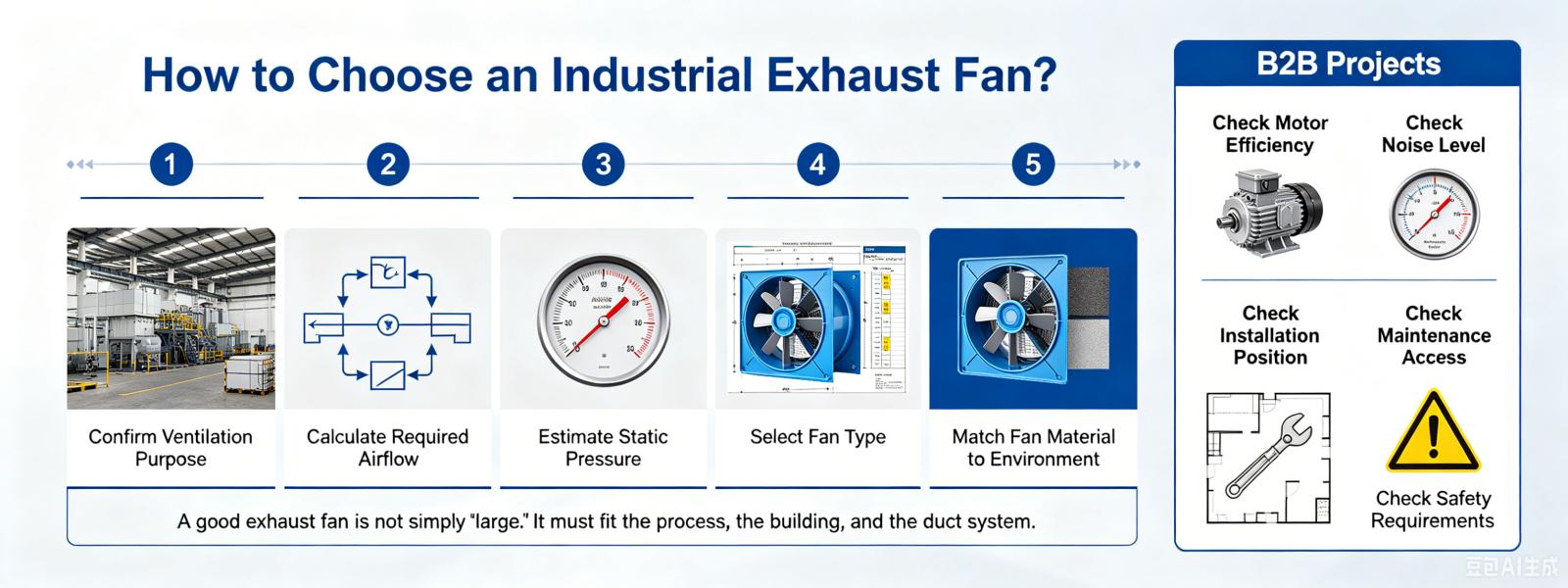
To choose an industrial exhaust fan, I first confirm the ventilation purpose. Then I calculate the required airflow, estimate static pressure, select the right fan type, and match the fan material to the environment. For B2B projects, I also check motor efficiency, noise level, installation position, maintenance access, and safety requirements. A good exhaust fan is not simply “large.” It must fit the process, the building, and the duct system.
If we treat the exhaust fan as part of our production system, we make a better purchase decision.
We reduce risk.
We also reduce long-term cost.
──────────────────────────────────────────────────
Quick Answer: What Should We Check Before Buying an Industrial Exhaust Fan?
Before I recommend any industrial exhaust fan, I check these key points:
- Ventilation goal: heat, smoke, dust, fumes, odor, or general air exchange.
- Required airflow: usually measured in m³/h, CMH, or CFM.
- Static pressure: duct resistance, filters, bends, dampers, and louvers.
- Fan type: axial fan, centrifugal fan, mixed-flow fan, or explosion-proof fan.
- Working environment: temperature, humidity, dust, corrosion, oil mist, or flammable gas.
- Motor and energy efficiency: because industrial fans may run many hours every day.
- Noise level: especially near offices, workers, or residential areas.
- Installation method: wall-mounted, roof-mounted, ducted, or equipment-mounted.
- Maintenance access: cleaning, bearing service, belt replacement, and spare parts.
For general ventilation principles, I often refer clients to the Canadian Centre for Occupational Health and Safety page on industrial ventilation.
Step 1: What Is the Main Ventilation Purpose?
I always start with one question.
What problem do we need the fan to solve?
This sounds simple.
But it decides almost everything.
A warehouse may only need fresh air exchange.
A welding shop may need smoke extraction.
A grinding room may need dust control.
A chemical area may need fume exhaust.
A high-temperature workshop may need heat removal.
Each application needs a different fan design.
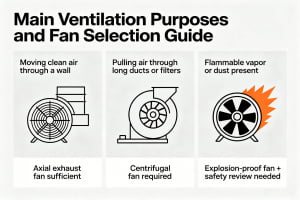
For example, if we only need to move clean air through a wall, an axial exhaust fan may be enough.
If we need to pull air through long ducts or filters, we may need a centrifugal fan.
If flammable vapor or dust is present, we may need an explosion-proof fan and a safety review.
So I never begin with fan size.
I begin with the application purpose.
That is the first correct step for B2B selection.
──────────────────────────────────────────────────
Step 2: How Much Airflow Do We Need?
Airflow is the amount of air the fan moves.
It is commonly shown as:
- m³/h
- CMH
- CFM
If airflow is too low, polluted air remains inside.
If airflow is too high, we waste energy and create more noise.
A common planning method is air changes per hour, also called ACH.
The basic formula is:
Required Airflow = Room Volume × Air Changes Per Hour
For example:
Workshop size = 40 m × 20 m × 6 m
Room volume = 4,800 m³
Target air changes = 10 ACH
Required airflow = 4,800 × 10 = 48,000 m³/h
So we may need one large fan or several smaller fans with a total airflow near 48,000 m³/h.
Here is a simple reference table I use during early planning.
| Industrial Area | Typical Ventilation Goal | Common Planning Range |
| Warehouse | General air exchange | 3–6 ACH |
| General workshop | Heat and odor removal | 6–10 ACH |
| Welding area | Smoke dilution and exhaust | 10–20 ACH |
| High-heat workshop | Heat removal | 15–30 ACH |
| Paint or chemical area | Fume control | Project-specific design |
These ranges are only for early estimation.
For better planning, I suggest checking the Engineering ToolBox reference on air change rates.
For hazardous fumes, dust, or chemical exposure, we should not rely on ACH alone.
We need a more detailed ventilation design.
Step 3: Why Is Static Pressure So Important?
Many buyers only ask for airflow.
That is not enough.
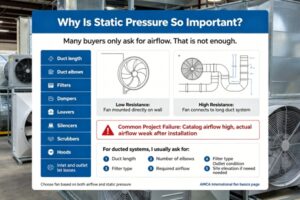
Static pressure is the resistance the fan must overcome.
Resistance comes from:
- Duct length
- Duct elbows
- Filters
- Dampers
- Louvers
- Silencers
- Scrubbers
- Hoods
- Inlet and outlet losses
If the fan is mounted directly on a wall, resistance may be low.
If the fan connects to a long duct system, resistance may be high.
This is where many projects fail.
A fan may have high airflow in the catalog.
But after installation, actual airflow becomes weak.
Why?
Because the fan cannot overcome the real system resistance.
For ducted systems, I usually ask for:
- Duct length
- Duct diameter
- Number of elbows
- Filter type
- Outlet condition
- Required airflow
- Site elevation if needed
Then we choose a fan based on both airflow and static pressure.
For more technical fan guidance, AMCA International provides useful education resources through its fan basics page.
Step 4: Should We Choose an Axial Fan or a Centrifugal Fan?
This is one of the most common B2B questions.
My answer is direct.
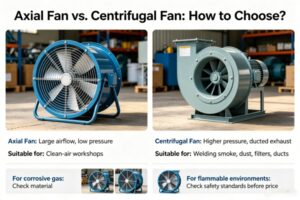
Use an axial fan when we need large airflow and low pressure.
Use a centrifugal fan when we need higher pressure or ducted exhaust.
Here is a simple comparison.
| Fan Type | Best For | Strength | Limitation |
| Axial exhaust fan | Wall exhaust, roof exhaust, general workshop ventilation | Large airflow, simple installation, lower cost | Not ideal for high static pressure |
| Centrifugal fan | Duct systems, filters, dust collectors, process exhaust | Higher pressure, stable airflow | Larger size and often higher cost |
| Mixed-flow fan | Medium-pressure duct ventilation | Balanced airflow and pressure | Needs careful selection |
| Explosion-proof fan | Flammable gas, vapor, or dust areas | Safer for hazardous zones | Must match site safety requirements |
| Anti-corrosion fan | Chemical, acid, alkali, or humid environments | Better material resistance | Material selection is critical |
For most clean-air workshops, an axial fan may work well.
For welding smoke, dust, filters, and ducts, I often look at centrifugal fans first.
For corrosive gas, I check material.
For flammable environments, I check safety standards before discussing price.
──────────────────────────────────────────────────
Step 5: What Working Environment Should We Consider?
An industrial exhaust fan does not work in a clean showroom.
It works in heat, dust, moisture, oil mist, and vibration.
So we must match the fan to the real site.
I usually check these details:
- Air temperature
- Humidity level
- Dust concentration
- Corrosive gas
- Oil mist
- Outdoor rain exposure
- Continuous running hours
- Flammable vapor or combustible dust
- Power supply condition
If the air is hot, we may need a high-temperature fan.
If the air contains acid or alkali, we may need FRP, stainless steel, or coated steel.
If the area contains flammable vapor, we may need explosion-proof construction.
If combustible dust exists, the risk must be taken seriously.
For safety awareness, I recommend reviewing NFPA information on combustible dust.
For workplace ventilation and safety, OSHA also provides resources related to ventilation.
In my view, environment matching is not optional.
It decides fan life, safety, and maintenance cost.
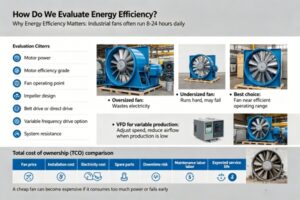
Step 6: How Do We Evaluate Energy Efficiency?
Energy efficiency matters because industrial fans often run for long periods.
Some run 8 hours per day.
Some run 24 hours per day.
A small difference in motor efficiency can become a large annual cost.
I always check:
- Motor power
- Motor efficiency grade
- Fan operating point
- Impeller design
- Belt drive or direct drive
- Variable frequency drive option
- System resistance
A larger motor is not always better.
If the fan is oversized, it may waste electricity.
If the fan is undersized, it may run hard and still fail.
The best choice is a fan that works near its efficient operating range.
For variable production, I often suggest a VFD.
A VFD allows us to adjust fan speed.
When production is low, we reduce airflow.
That can reduce energy use.
For B2B purchasing, I always compare the total cost of ownership, not only the purchase price.
That includes:
- Fan price
- Installation cost
- Electricity cost
- Spare parts
- Downtime risk
- Maintenance labor
- Expected service life
A cheap fan can become expensive if it consumes too much power or fails early.
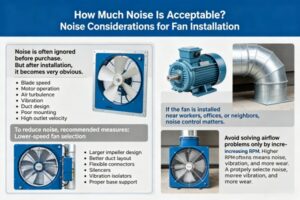
Step 7: How Much Noise Is Acceptable?
Noise is often ignored before purchase.
But after installation, it becomes very obvious.
Fan noise comes from:
- Blade speed
- Motor operation
- Air turbulence
- Vibration
- Duct design
- Poor mounting
- High outlet velocity
If the fan is installed near workers, offices, or neighbors, noise control matters.
To reduce noise, I may recommend:
- Lower-speed fan selection
- Larger impeller design
- Better duct layout
- Flexible connectors
- Silencers
- Vibration isolators
- Proper base support
I do not like solving airflow problems only by increasing RPM.
Higher RPM often means more noise, more vibration, and more wear.
A properly selected fan is usually quieter and more stable.
──────────────────────────────────────────────────
Step 8: Where Should We Install the Industrial Exhaust Fan?
Installation position affects real performance.
A good fan in a bad position may perform poorly.
For heat removal, I prefer high-level exhaust points.
Hot air rises.
So roof exhaust or upper-wall exhaust often works better.
For general workshop ventilation, I also check the fresh air path.
Air should enter from the opposite side or lower area.
This creates better airflow across the space.
If we install exhaust fans but do not provide makeup air, the system may struggle.
Common problems include:
- Lower actual airflow
- Strong negative pressure
- Doors becoming hard to open
- More fan noise
- Poor air movement
- Motor overload risk
For ducted exhaust, I avoid sharp bends near the fan.
I also keep maintenance space around the fan.
This helps technicians inspect bearings, belts, guards, and wiring.
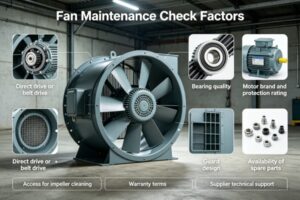
Step 9: What Maintenance Factors Should We Check?
Industrial fans need maintenance.
Dust builds up.
Belts loosen.
Bearings wear.
Motors heat up.
Fasteners vibrate.
So I always check service access before confirming a fan.
Important maintenance factors include:
- Direct drive or belt drive
- Bearing quality
- Motor brand and protection grade
- Impeller cleaning access
- Guard design
- Spare parts availability
- Warranty terms
- Supplier technical support
Direct drive fans usually need less maintenance.
Belt drive fans offer speed flexibility, but belts require inspection.
If dust sticks to the impeller, fan balance can become poor.
That can increase vibration and shorten bearing life.
For B2B buyers, after-sales support is important.
A fan failure may stop a production line.
So I prefer suppliers who can provide drawings, performance data, spare parts, and technical guidance.
──────────────────────────────────────────────────
More Related Questions
How Do I Know If My Industrial Exhaust Fan Is Too Small?
Your fan may be too small if heat, smoke, odor, or dust remains in the workshop.
Other signs include weak airflow, high indoor temperature, and worker complaints.
But the fan may not be the only problem.
We should also check duct blockage, dirty filters, poor air inlet design, and static pressure.
──────────────────────────────────────────────────
Can One Large Fan Replace Several Smaller Fans?
Sometimes yes.
But I do not always recommend it.
One large fan may simplify control.
Several smaller fans may give better airflow distribution.
They also reduce risk.
If one small fan stops, the whole system does not fail.
For large workshops, multiple exhaust points often work better.
──────────────────────────────────────────────────
Is Higher RPM Always Better?
No.
Higher RPM may increase airflow.
But it can also increase noise, vibration, energy use, and wear.
I prefer selecting by fan curve, airflow, pressure, efficiency, and site conditions.
Speed alone is not a reliable selection method.
──────────────────────────────────────────────────
What Information Should We Send to a Fan Supplier?
For an accurate quotation, I suggest sending:
- Workshop size
- Ventilation purpose
- Required airflow
- Duct layout
- Static pressure estimate
- Air temperature
- Dust or gas type
- Indoor or outdoor installation
- Power supply
- Noise requirements
- Safety requirements
- Quantity
- Installation photos or drawings
The more complete the information, the better the recommendation.
──────────────────────────────────────────────────
Conclusion
Choosing an industrial exhaust fan is not about buying the biggest model. I focus on airflow, static pressure, fan type, environment, efficiency, noise, installation, and maintenance. When these factors match, we get safer ventilation, lower operating cost, and more reliable factory performance.