Exhaust Fan CFM Chart: How to Choose the Right Size?
Poor ventilation is not a small problem. It creates moisture, odor, heat, smoke, and indoor air quality issues. I have seen bathrooms grow mold because the fan was too weak. I have seen kitchens stay smoky because the duct was too long. I have also seen buyers choose a fan only by size, price, or appearance. That usually leads to poor performance. The real starting point is simple: choose the exhaust fan by CFM and application.
The right exhaust fan size depends on the airflow you need. Airflow is measured in CFM, or cubic feet per minute. For quick selection, use an exhaust fan CFM chart based on room type. Then confirm the size by room volume, air changes per hour, duct length, bends, and noise level. A small bathroom may need 50 CFM. A large kitchen, garage, or commercial space may need several hundred CFM or more.
I am Jason. I work with exhaust fans, ventilation products, and airflow selection. In this guide, I will show you how I choose the right exhaust fan size in a practical way.
──────────────────────────────────────────────────
Key Takeaways
- CFM means cubic feet per minute.
- Higher CFM means more air movement.
- Bathroom exhaust fans often start at 50 CFM.
- A common bathroom rule is about 1 CFM per square foot.
- Kitchen exhaust fans usually need more CFM than bathroom fans.
- Duct length, elbows, and duct diameter can reduce real airflow.
- The best fan is not always the biggest fan.
- Correct sizing means balanced airflow, lower noise, and better ventilation.
──────────────────────────────────────────────────
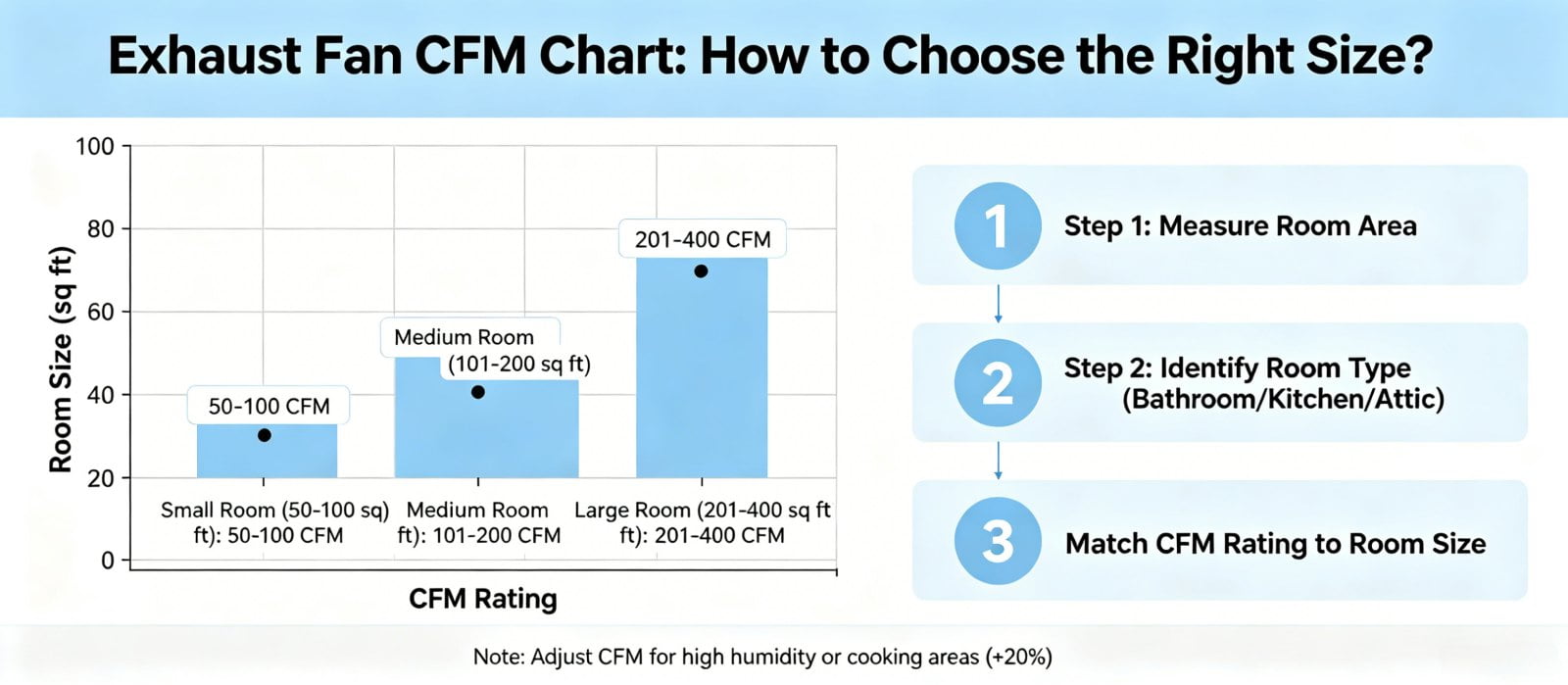
Exhaust Fan CFM Chart
Use this chart as a quick starting point.
| Room or Application | Suggested Exhaust Fan CFM |
| Small bathroom under 50 sq. ft. | 50 CFM |
| Medium bathroom, 50–80 sq. ft. | 80 CFM |
| Large bathroom, 80–110 sq. ft. | 100–110 CFM |
| Bathroom with shower, tub, and toilet | 100–150 CFM |
| Laundry room | 100–150 CFM |
| Small residential kitchen | 150–300 CFM |
| Heavy cooking kitchen | 300–600+ CFM |
| Residential garage | 200–600 CFM |
| Workshop | 300–1,000+ CFM |
| Commercial restroom | Code-based sizing |
| Commercial kitchen | Hood and code-based sizing |
My advice: use the chart first. Then calculate. Then adjust for duct conditions.
For certified residential ventilation fan performance, I often check the Home Ventilating Institute certified product directory.
──────────────────────────────────────────────────
What Is CFM?
CFM means cubic feet per minute.
It tells us how much air an exhaust fan can move in one minute.
For example:
100 CFM = 100 cubic feet of air moved per minute
That sounds simple. But real airflow can be lower after installation.
Why?
Because the fan may face resistance from:
- Long duct runs
- Small duct diameter
- Too many elbows
- Dirty grilles
- Poor outlet design
- Weak makeup air
So I always remind buyers: rated CFM is not always the same as installed CFM.
For general ventilation background, you can review the EPA indoor air quality guide.

How to Calculate Exhaust Fan CFM
I use this simple formula:
First, calculate room volume:
Room Volume = Length × Width × Height
Example:
A room is:
- 10 ft long
- 8 ft wide
- 8 ft high
10 × 8 × 8 = 640 cubic feet
If I want 8 air changes per hour:
640 × 8 ÷ 60 = 85.3 CFM
So I would choose at least a 90 CFM exhaust fan.
If the duct is long, I may choose 100 CFM or 110 CFM.
For air change concepts, the CDC provides useful technical information on air changes per hour.
Bathroom Exhaust Fan CFM Chart
Bathrooms need exhaust because they create moisture fast.
Steam from showers can stay on walls, mirrors, ceilings, and paint. If the fan is too weak, moisture stays longer.
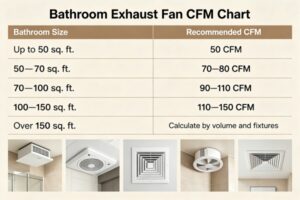
Here is my practical bathroom chart:
| Bathroom Size | Recommended CFM |
| Up to 50 sq. ft. | 50 CFM |
| 50–70 sq. ft. | 70–80 CFM |
| 70–100 sq. ft. | 90–110 CFM |
| 100–150 sq. ft. | 110–150 CFM |
| Over 150 sq. ft. | Calculate by volume and fixtures |
A common residential rule is:
Bathroom CFM ≈ Bathroom square feet
So a 90 sq. ft. bathroom needs about 90 CFM.
I usually round up.
If the result is 90 CFM, I may choose a 100 CFM fan.
ENERGY STAR also provides useful information about ventilating fans.
──────────────────────────────────────────────────
Bathroom Fixture Method
For larger bathrooms, I also look at fixtures.
A larger bathroom may have:
- Toilet
- Shower
- Bathtub
- Jetted tub
- Double vanity
- Separate wet zone
More fixtures mean more moisture and odor sources.
If the bathroom has a separate toilet room, I may recommend a second small exhaust fan.
That often works better than one oversized fan placed far away.
Fan placement matters. A good fan in the wrong location may still perform badly.
Kitchen Exhaust Fan CFM Chart
Kitchens need stronger exhaust than bathrooms.
Why?
Because cooking creates:
- Heat
- Smoke
- Odor
- Steam
- Grease particles
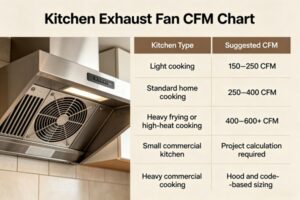
Here is my kitchen CFM chart:
| Kitchen Type | Suggested CFM |
| Light cooking | 150–250 CFM |
| Standard home cooking | 250–400 CFM |
| Heavy frying or high-heat cooking | 400–600+ CFM |
| Small commercial kitchen | Project calculation required |
| Heavy commercial cooking | Hood and code-based sizing |
For kitchens, I do not size only by room area.
I check:
- Cooking style
- Heat level
- Range or equipment size
- Duct path
- Hood design
- Makeup air
- Local code
For commercial projects, I always recommend checking local requirements and professional ventilation standards. ASHRAE publishes recognized standards and guidelines.
──────────────────────────────────────────────────
Laundry Room Exhaust Fan CFM
Laundry rooms are small, but they can be humid.
They may contain:
- Wet clothes
- Dryer heat
- Detergent smell
- Limited airflow
- Lint particles
For most laundry rooms, I start with:
100–150 CFM
If the room is enclosed or used heavily, I may go higher.
Important point: keep the grille and duct clean. Lint buildup reduces airflow.
A fan may be correctly sized when new. But if lint blocks the airflow, performance drops.
──────────────────────────────────────────────────
Garage Exhaust Fan CFM
Garage ventilation depends on how the space is used.
A garage may be used for:
- Parking
- Storage
- DIY work
- Fitness
- Woodworking
- Light repairs
For a basic residential garage, I often start around:
200–600 CFM
For a workshop, airflow may need to be higher:
300–1,000+ CFM
But I need to be clear.
An exhaust fan is not a complete safety system. If chemicals, fumes, fuel, combustion gas, or dust are involved, the ventilation design must be handled carefully.
For workplace ventilation topics, OSHA has a useful ventilation resource.

Duct Size and Duct Length
This is one of the most important parts.
A fan does not work alone. It works with the duct system.
Poor duct design can reduce airflow badly.
Common duct problems include:
- Duct too small
- Duct too long
- Too many elbows
- Crushed flexible duct
- Blocked wall cap
- No backdraft damper
- Poor roof outlet
If a fan is rated at 100 CFM, it may not deliver 100 CFM through a bad duct.
That is why I always check static pressure.
Static pressure is airflow resistance. The more resistance the fan must overcome, the less air it may move.
For professional selection, I prefer looking at the fan curve or performance data, not only the free-air CFM rating.
──────────────────────────────────────────────────
Can an Exhaust Fan Be Too Powerful?
Yes.
Bigger is not always better.
An oversized exhaust fan may create problems:
- Higher noise
- Higher energy use
- Negative pressure
- Drafts
- Loss of heated or cooled indoor air
- Need for makeup air
Makeup air means replacement air.
If we exhaust air from a room, new air must enter. If not, the fan struggles.
In kitchens and commercial spaces, makeup air is especially important.
So I do not simply choose the highest CFM fan. I choose the right CFM fan.
──────────────────────────────────────────────────
Noise Level Matters
CFM is important. But noise matters too.
A loud fan often gets turned off.
If users turn off the fan, ventilation fails.
For bathrooms, hotels, apartments, offices, and bedrooms nearby, I pay close attention to sound level.
Many fan sound ratings are shown in sones.
Lower sone rating means quieter operation.
When choosing a fan, I look for a balance:
- Enough CFM
- Acceptable noise
- Good motor quality
- Correct duct size
- Reliable certification
──────────────────────────────────────────────────
Certification and Market Requirements
For buyers, importers, contractors, and OEM brands, certification can be just as important as airflow.
Depending on the target market, exhaust fans may need certifications or compliance marks.
Examples include:
- HVI performance certification
- ENERGY STAR efficiency listing
- ETL or UL safety listing
- CE marking for the European market
- RoHS compliance
- SAA approval for Australia
For North America, ETL information is available from Intertek ETL listed mark.
For Europe, official CE information is available from the European Commission page on CE marking.
My advice: choose the fan size first. Then check certification before purchase.
A fan that performs well but cannot enter your target market is not the right fan.

Step-by-Step: How I Choose the Right Exhaust Fan Size
Here is my practical sizing process.
Step 1: Identify the Room Type
I first ask:
- Is it a bathroom?
- Is it a kitchen?
- Is it a laundry room?
- Is it a garage?
- Is it a commercial space?
Application decides the starting CFM range.
──────────────────────────────────────────────────
Step 2: Use the CFM Chart
I choose an initial CFM from the chart.
This gives me a quick reference.
Example:
- Small bathroom: 50 CFM
- Medium bathroom: 80 CFM
- Standard kitchen: 250–400 CFM
- Laundry room: 100–150 CFM
──────────────────────────────────────────────────
Step 3: Measure the Room
I measure:
- Length
- Width
- Height
Then I calculate room volume.
Length × Width × Height = Room Volume
Ceiling height matters. A room with a high ceiling contains more air.
──────────────────────────────────────────────────
Step 4: Calculate CFM
I use:
CFM = Room Volume × ACH ÷ 60
Then I compare the result with the chart.
If the chart says 80 CFM and the formula says 85 CFM, I choose around 90–100 CFM.
──────────────────────────────────────────────────
Step 5: Check the Duct
I check:
- Duct diameter
- Duct length
- Number of elbows
- Outlet type
- Backdraft damper
- Installation path
If the duct is difficult, I may increase the fan size or change the duct design.
Do not ignore ducts. They can make a good fan perform like a weak fan.
──────────────────────────────────────────────────
Step 6: Check Noise and Efficiency
I then check:
- Noise rating
- Motor type
- Energy use
- Bearing quality
- Housing design
- Installation method
For residential applications, quiet operation is very important.
──────────────────────────────────────────────────
Step 7: Check Certification
Finally, I check whether the fan fits the market.
For example:
- USA or Canada may need ETL or UL-style listing.
- EU market may need CE-related compliance.
- Performance-sensitive buyers may prefer HVI-certified data.
A good exhaust fan should be correctly sized, properly certified, and easy to install.
Common Exhaust Fan Sizing Mistakes
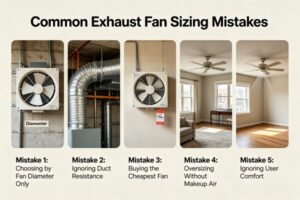
Mistake 1: Choosing by Fan Diameter Only
A 6-inch fan is not always better than a 4-inch fan.
Motor design matters. Blade design matters.Static pressure matters.
Always check CFM.
──────────────────────────────────────────────────
Mistake 2: Ignoring Duct Resistance
This is the mistake I see most often.
A buyer chooses a 100 CFM fan. Then installs it with a long, narrow, twisted duct.
The result is weak airflow.
The duct system must support the fan.
──────────────────────────────────────────────────
Mistake 3: Buying the Cheapest Fan
Low price can be tempting.
But a weak fan may be noisy, inefficient, or short-lived.
For long-term use, I look at:
- Motor quality
- Bearing quality
- Airflow rating
- Noise level
- Certification
- Housing material
──────────────────────────────────────────────────
Mistake 4: Oversizing Without Makeup Air
High CFM removes air fast.
But if replacement air cannot enter, performance drops.
This is common in kitchens and commercial rooms.
Exhaust air must be replaced by makeup air.
──────────────────────────────────────────────────
Mistake 5: Ignoring User Comfort
A fan that is too loud may not be used.
That is a real failure.
The best exhaust fan is not only powerful. It is also quiet enough for daily use.
──────────────────────────────────────────────────
More Related Questions
Is 50 CFM Enough for a Bathroom?
Yes, 50 CFM can be enough for a small bathroom under about 50 sq. ft.
For larger bathrooms, I usually choose 80 CFM, 100 CFM, or more.
──────────────────────────────────────────────────
Is Higher CFM Always Better?
No. Higher CFM is not always better.
Too much airflow can increase noise, waste energy, and create negative pressure.
The goal is correct airflow, not maximum airflow.
──────────────────────────────────────────────────
What Happens If My Exhaust Fan Is Too Small?
If the fan is too small, you may notice:
- Moisture stays longer
- Mirrors remain foggy
- Odors linger
- Mold risk increases
- Paint may peel
- Kitchen smoke spreads
Undersized fans create long-term problems.
──────────────────────────────────────────────────
Should I Choose a Wall Exhaust Fan or Ceiling Exhaust Fan?
It depends on the room and duct path.
- Ceiling fans are common in bathrooms.
- Wall fans are useful for direct sidewall exhaust.
- Inline duct fans are useful when the fan needs to be remote-mounted.
I choose the type based on installation conditions.
──────────────────────────────────────────────────
How Do I Know If My Exhaust Fan Is Working Well?
I check several signs:
- Air is moving at the grille
- Moisture clears quickly
- Odor does not linger
- Noise is acceptable
- Backdraft damper works
- Outlet is not blocked
If performance is weak, I inspect the duct first.
──────────────────────────────────────────────────
Conclusion
Choose exhaust fan CFM by room type, room volume, duct condition, and real ventilation demand. Start with the chart. Calculate the airflow. Check ducts and noise. Then confirm certification. That is how I choose the right exhaust fan size with confidence.