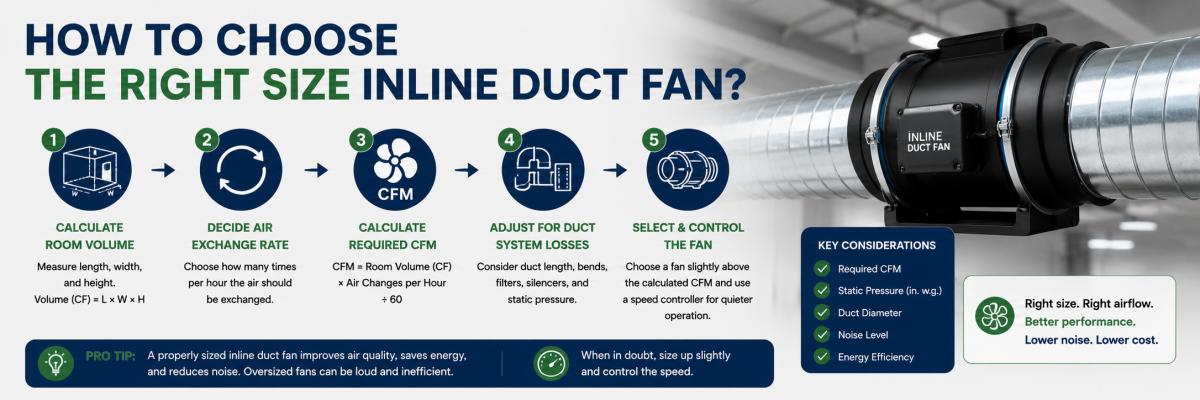
Bad airflow can make a room feel uncomfortable fast. I’ve seen it happen in bathrooms, grow rooms, workshops, attics, and HVAC duct runs. The air feels stale. Humidity stays high. Odors linger. Then people buy a random inline duct fan and hope it works. That usually creates a new problem. The fan may be too weak, too loud, or too expensive to run. The good news is simple. You can choose the right inline duct fan size by calculating airflow demand, then adjusting for duct design.
To choose the right size inline duct fan, I first calculate the room volume in cubic feet. Then I decide how often the air should be exchanged. This gives me the required CFM, or cubic feet per minute. After that, I adjust for duct length, bends, filters, silencers, and static pressure. In most cases, I size the fan slightly above the calculated CFM and control it with a speed controller for quieter operation.
I don’t like guessing with ventilation. It wastes money. It also creates poor results. So let me walk you through the method I use when I size an inline duct fan.
What Is an Inline Duct Fan?
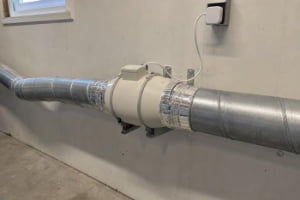
An inline duct fan is a fan installed inside ducting to move air from one place to another.
It can remove humid air.
It can boost weak airflow.
It can pull hot air out of a room.
It can also support ventilation in grow tents, bathrooms, kitchens, garages, and HVAC systems.
The fan is usually connected to round ducting. Common duct diameters include 4 inch, 6 inch, 8 inch, 10 inch, and 12 inch.
The most important rating is CFM, which means cubic feet per minute. CFM tells us how much air the fan can move.
Why Does Inline Duct Fan Size Matter?
Fan size matters because airflow must match the space.
If the fan is too small, it cannot remove enough air.
That can cause:
- High humidity
- Stale air
- Lingering odors
- Heat buildup
- Poor indoor air quality
- Possible mold risk in damp areas
If the fan is too large, it may cause:
- Excess noise
- Higher energy use
- Uncomfortable drafts
- Negative pressure problems
- Reduced filter life
- Unstable temperature or humidity
This is why I always say: the right fan is not the biggest fan. It is the fan that matches the airflow requirement.

How Do I Calculate the Right CFM for an Inline Duct Fan?
The basic formula is simple.
Room volume = length × width × height
Then:
Required CFM = room volume ÷ desired air exchange time
Let’s say I have a room that is:
- 10 feet long
- 10 feet wide
- 8 feet high
The room volume is:
10 × 10 × 8 = 800 cubic feet
If I want one full air exchange every minute, I need:
800 ÷ 1 = 800 CFM
If I want one full air exchange every two minutes, I need:
800 ÷ 2 = 400 CFM
So the right fan size depends on how quickly I need to replace the air.
What Air Exchange Rate Should I Use?
Different spaces need different air exchange rates.
A bathroom does not have the same ventilation demand as a grow room.
A workshop does not have the same demand as a storage room.
Here is a practical table I use as a starting point.
| Space Type | Common Ventilation Goal | Basic Sizing Method |
| Bathroom | Moisture removal | Often sized by room area or CFM need |
| Grow tent / grow room | Fast heat and humidity control | 1 air exchange every 1–3 minutes |
| Workshop | Odor, dust, or heat removal | Depends on use |
| Attic or crawlspace | Moisture and heat management | Depends on code and design |
| General room ventilation | Fresh air support | Slower air exchange may be enough |
This table gives a baseline.
But I never stop here.
I still adjust for duct restrictions.
How Do Duct Length and Bends Affect Fan Size?
This is where many people make mistakes.
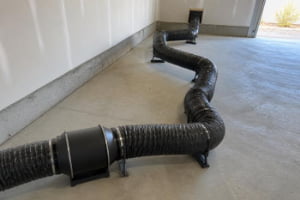
A fan may be rated for 400 CFM, but that does not mean it will deliver 400 CFM after air moves through long ducting, elbows, filters, and dampers.
Every restriction creates resistance.
This resistance is called static pressure.
The higher the static pressure, the harder the fan must work.
That means actual airflow drops.
I always check the duct path before I choose the fan.
I look at:
- Total duct length
- Number of bends
- Duct diameter
- Filter resistance
- Backdraft dampers
- Silencers
- Exhaust grilles
- Intake restrictions
If the duct run is long or complicated, I size up.
Not wildly.
Just enough to protect airflow.
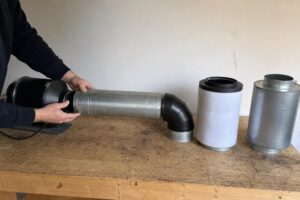
How Much Extra CFM Should I Add for Duct Loss?
Here is a simple field table I use when I need a quick adjustment.
| Duct Condition | Suggested CFM Adjustment | Why I Add It |
| Short, straight duct under 10 ft | Add 0–10% | Low resistance |
| Medium duct run, 10–25 ft | Add 10–20% | Normal friction loss |
| Long duct run over 25 ft | Add 20–30% | More static pressure |
| Multiple 90° bends | Add 10–30% | Bends reduce airflow |
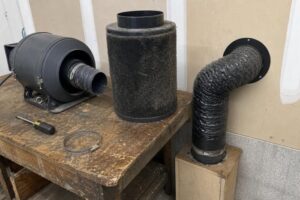
| Carbon filter installed | Add 20–40% | Filters create resistance |
| Silencer installed | Add 5–15% | Some airflow loss |
| Flexible ducting | Add 10–25% | Ridges increase friction |
For example, if my calculated need is 400 CFM, and I have a carbon filter plus several bends, I may choose a fan rated around 550–650 CFM.
Then I use a controller to dial it down.
That gives me airflow headroom.
It also keeps the fan quieter.
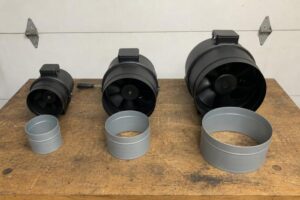
What Inline Duct Fan Diameter Should I Choose?
Fan diameter matters too.
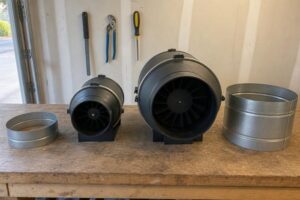
A 4-inch fan and an 8-inch fan can both move air.
But they do not move it the same way.
A larger duct fan can usually move more air at a lower speed.
That often means less noise.
Here is my simple approach:
- 4-inch inline fan: small cabinets, small tents, light ventilation
- 6-inch inline fan: small rooms, medium grow tents, bathrooms, general use
- 8-inch inline fan: larger rooms, stronger exhaust needs, longer duct runs
- 10-inch or larger fan: commercial spaces, large grow rooms, serious airflow demand
I do not recommend reducing duct size unless needed.
For example, using an 8-inch fan with a 6-inch duct can increase noise and pressure.
I prefer matching the fan size to the duct size whenever possible.
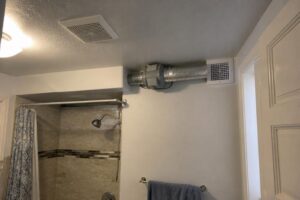
How Do I Choose an Inline Duct Fan for a Bathroom?
Bathrooms need moisture control.
If the fan is too weak, steam stays in the room.
That can lead to peeling paint, odors, and mold concerns.
The EPA has helpful information about moisture and indoor air quality on its Indoor Air Quality page.
For a bathroom, I look at:
- Bathroom size
- Shower or tub use
- Duct length
- Number of elbows
- Fan noise rating
- Exterior vent location
If the bathroom has a long duct run to the roof or wall, I choose a stronger inline fan than the basic room size suggests.
I also like using a timer or humidity controller.
That way, the fan keeps running after showers.

How Do I Choose an Inline Duct Fan for a Grow Room?
Grow rooms are more demanding.
Plants release moisture.
Lights create heat.
Carbon filters reduce airflow.
So I always size grow room fans more carefully.
My basic grow room method is:
- Calculate room volume
- Target one air exchange every 1–3 minutes
- Add CFM for heat load
- Add CFM for carbon filter resistance
- Add CFM for duct bends
- Use a speed controller
Example:
A grow tent is 4 ft × 4 ft × 7 ft.
Room volume:
4 × 4 × 7 = 112 cubic feet
If I want one air exchange per minute:
112 CFM minimum
But if I add a carbon filter, LED heat, and flexible ducting, I may choose a fan closer to 200–250 CFM.
Then I control the speed.
This gives me stable airflow without running the fan at full power all day.
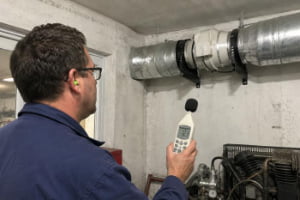
How Important Is Noise When Choosing Fan Size?
Noise is very important.
I have seen people buy powerful fans and then stop using them because they are too loud.
That defeats the purpose.
Fan noise is often measured in sones or decibels.
To reduce noise, I recommend:
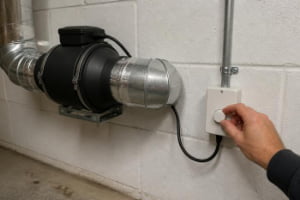
- Choose a slightly larger fan and run it slower
- Use insulated ducting where appropriate
- Avoid sharp duct bends
- Mount the fan with vibration control
- Use a silencer if noise matters
- Avoid undersized ducting
- Do not run the fan at max speed unless necessary
In my experience, a fan running at 60–70% speed is usually much more pleasant than a smaller fan screaming at 100%.
Should I Buy a Bigger Inline Duct Fan Than I Need?
Sometimes, yes.
But not too big.
I like having airflow headroom.
A slightly larger fan gives flexibility.
It helps overcome filters, bends, and future duct changes.
But an oversized fan without speed control can be annoying.
It may create noise.
It may pull conditioned air out too quickly.
It may also cause pressure issues.
My rule is simple:
Size the fan 10–30% above your real adjusted CFM need, then use a speed controller.
That gives us control.
Control is better than guessing.
What Common Mistakes Should I Avoid?
Here are the mistakes I see most often.
1. Guessing the fan size
This is the biggest mistake.
Do not buy based only on duct diameter.
A 6-inch fan may be weak or powerful depending on the model.
Always check the CFM rating.
2. Ignoring duct restrictions
Long ducting reduces airflow.
Bends reduce airflow.
Filters reduce airflow.
I always adjust for them.
3. Buying only by price
Cheap fans may work.
But they may also be loud, inefficient, or short-lived.
I check performance data before buying.
4. Forgetting maintenance
Dirty filters and dusty blades reduce airflow.
A fan that worked well last year may perform poorly now.
5. Using flexible duct everywhere
Flexible duct is easy to install.
But it creates more resistance than smooth rigid duct.
I use smooth duct when airflow matters.
My Inline Duct Fan Sizing Checklist
Before I buy any inline duct fan, I go through this checklist.
- Measure the room length, width, and height
- Calculate room volume
- Choose the air exchange target
- Calculate base CFM
- Add CFM for duct length
- Add CFM for bends
- Add CFM for filters or silencers
- Match fan diameter to duct diameter
- Check noise level
- Check energy efficiency
- Use a speed controller if possible
- Confirm installation space
- Plan maintenance access
This keeps the process simple.
It also prevents expensive mistakes.

More Related Questions
What happens if my inline duct fan is too small?
If the fan is too small, it will not move enough air.
You may notice humidity, odors, heat buildup, or weak airflow.
The fan may also run constantly, which can shorten its service life.
What happens if my inline duct fan is too large?
If the fan is too large, it can be loud.
It may waste energy.
It may also pull air too aggressively.
That can cause drafts or pressure imbalance.
Can I use a speed controller with an inline duct fan?
Yes, if the fan supports speed control.
I recommend checking the manufacturer’s instructions first.
A controller helps fine-tune airflow and reduce noise.
Is CFM the only thing that matters?
No.
CFM is important, but static pressure is just as important.
A fan with a high free-air CFM rating may perform poorly in restrictive ducting.
Should I choose AC or EC motor fans?
I prefer EC motor fans when budget allows.
They are often more efficient and easier to control.
But a good AC inline fan can still work well for basic ventilation.
Conclusion
Choosing the right inline duct fan is about matching airflow to the real system. I calculate CFM, adjust for duct resistance, and choose a fan with controlled headroom. That gives us better ventilation, lower noise, and a setup that works in the real world.