Struggling with keeping your warehouse cool in scorching summers? The heat can drain your team’s energy, reduce productivity, and even damage sensitive goods. I’ve been there—walking into a suffocating warehouse with stuffy air hanging over every aisle. This challenge pushes many warehouse managers to ask: Should I choose a pedestal fan or wall fan for better cooling? I’ll help you make an informed decision, so you don’t have to sweat it out or risk making costly mistakes.
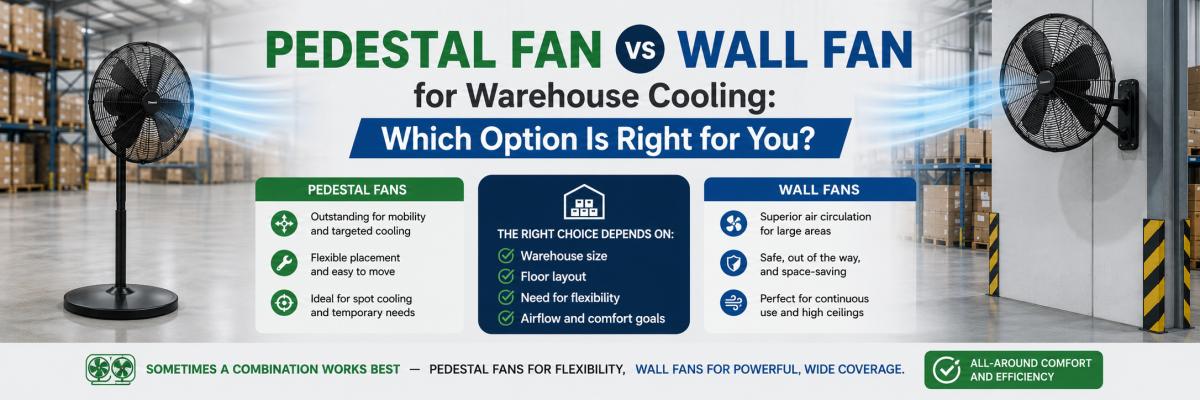
For most warehouses, pedestal fans are outstanding for mobility and targeted cooling, while wall fans offer superior air circulation and safety. Your ideal choice depends on warehouse size, floor layout, and the need for flexibility. Sometimes a combination works best for all-around comfort and efficiency.
Let’s dive in. I’ll share my expert thoughts, provide data tables, and answer your most-asked questions about these fan types.

What Are The Key Differences Between Pedestal Fans and Wall Fans?
Pedestal Fans
- Definition: Freestanding fans with adjustable height and direction.
- Best For: Moving airflow to specific locations, flexible layouts, and temporary cooling needs.
- Setup: Quick assembly, plug-and-play use.
Wall Fans
- Definition: Fans mounted high on walls, angled for wide coverage.
- Best For: Warehouses with high ceilings, crowded floors, and a need for unobstructed workflow.
- Setup: Requires brackets, wall mounting, and sometimes hardwiring.
Comparison Table 1: Key Features of Pedestal vs Wall Fans
| Feature | Pedestal Fan | Wall Fan |
| Mobility | High – Can be moved anywhere | Fixed – Stays where mounted |
| Airflow Direction | Adjustable, local area | Broad, covers large open areas |
| Setup Time | Minimal, no installation required | Moderate, needs wall mounting |
| Floor Space Required | Yes, takes up space on the floor | No, keeps floors clear |
| Safety | Can be a trip hazard due to cords | Out of the way, safer for staff & machinery |
Which Fan Type Delivers Better Cooling?
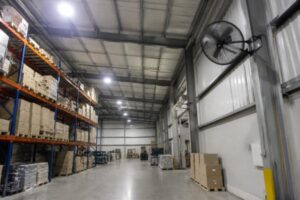
Wall fans are generally better for overall warehouse cooling because they circulate air from above, reducing hot spots and keeping air moving across multiple workstations.
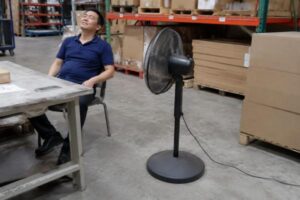
Pedestal fans are perfect if you need spot cooling—just position them where your staff needs relief the most.
Comparison Table 2: Cooling Coverage and Use Cases
| Application Scenario | Pedestal Fan | Wall Fan |
| Spot cooling (specific zones) | Excellent | Average |
| Open, unobstructed layouts | Good | Excellent |
| Changing workstations/flexible needs | Excellent | Poor |
| Busy floors/high traffic | Risk of trips | Safe, out of the way |

How Difficult Is Installation and Maintenance?
Pedestal fans are easy—just plug and play. They need frequent cleaning, especially near dusty warehouses.
Wall fans require more setup time for secure mounting, but once installed, they’re easy to maintain and less prone to workplace damage.
- Pedestal fan installation: No tools, done in minutes.
- Wall fan installation: Needs drilling and mounting, sometimes an electrician’s support.

What Are the Safety and Cost Considerations?
Safety: Pedestal fans can cause trips, especially in high-traffic aisles. Wall fans are safely mounted overhead, preventing accidents and keeping pathways clear.
Cost:
- Initial cost: Pedestal fans are usually cheaper to buy and set up.
- Long-term savings: Wall fans last longer due to less accidental damage, potentially lowering lifetime costs.
- Maintenance: Both types need regular cleaning for best airflow and efficiency.
──────────────────────────────────────────────────
Should I Use Both Fan Types in My Warehouse?
Absolutely! Mixing wall fans for general airflow and pedestal fans for targeted hot spots creates a flexible, efficient cooling solution. This combination can help maintain consistent temperatures, reduce energy usage, and prevent employee complaints.
More Related Questions
- What fan size is best for a 10,000 sq ft warehouse?
For large spaces around 10,000 sq ft, consider multiple industrial wall fans (24–30 inches) every 15–30 feet for even coverage. You may also add larger pedestal fans (24–30 inches) for movable, localized cooling.
- Can pedestal or wall fans replace HVAC systems?
No, fans circulate air but do not lower the air temperature. They can improve comfort and supplement how well HVAC systems work, but in extreme heat, AC or proper ventilation is still necessary.
- What about energy savings—are some fans more efficient?
Generally, wall fans use less power for wider airflow patterns, while pedestal fans use a bit more for the same coverage. Both types are far more energy-efficient than air conditioning. Look for fans with high CFM (cubic feet per minute) ratings for greater efficiency.
- How do you clean and maintain warehouse fans?
For both types, unplug the fan, wipe blades with a damp cloth, and remove dust from motor housing monthly. Wall fans may need a ladder or lift for safe cleaning. Lubricate moving parts annually for best performance.
- Do noise levels differ between pedestal and wall fans?
Wall fans are usually quieter because they’re mounted further from workers’ ears. Pedestal fans, if placed nearby, can be noisier but often feature variable speeds for noise control.
──────────────────────────────────────────────────
Conclusion
Choosing between pedestal and wall fans comes down to flexibility, space, and airflow needs. For the safest and most effective cooling, you may want to use both. Have more questions? Reach out or comment below—I’m here to help!