Best Ventilation Fans for Factory: Which One Should You Choose?
Poor factory ventilation creates a problem many facility managers notice too late: heat builds up, fumes linger, dust spreads, and workers become uncomfortable. When air does not move correctly, production areas can feel unsafe and inefficient. This can lead to lower productivity, more maintenance issues, and higher energy costs. The frustrating part is that many factories already have fans installed, but the fans are either undersized, poorly placed, or not designed for industrial ventilation.
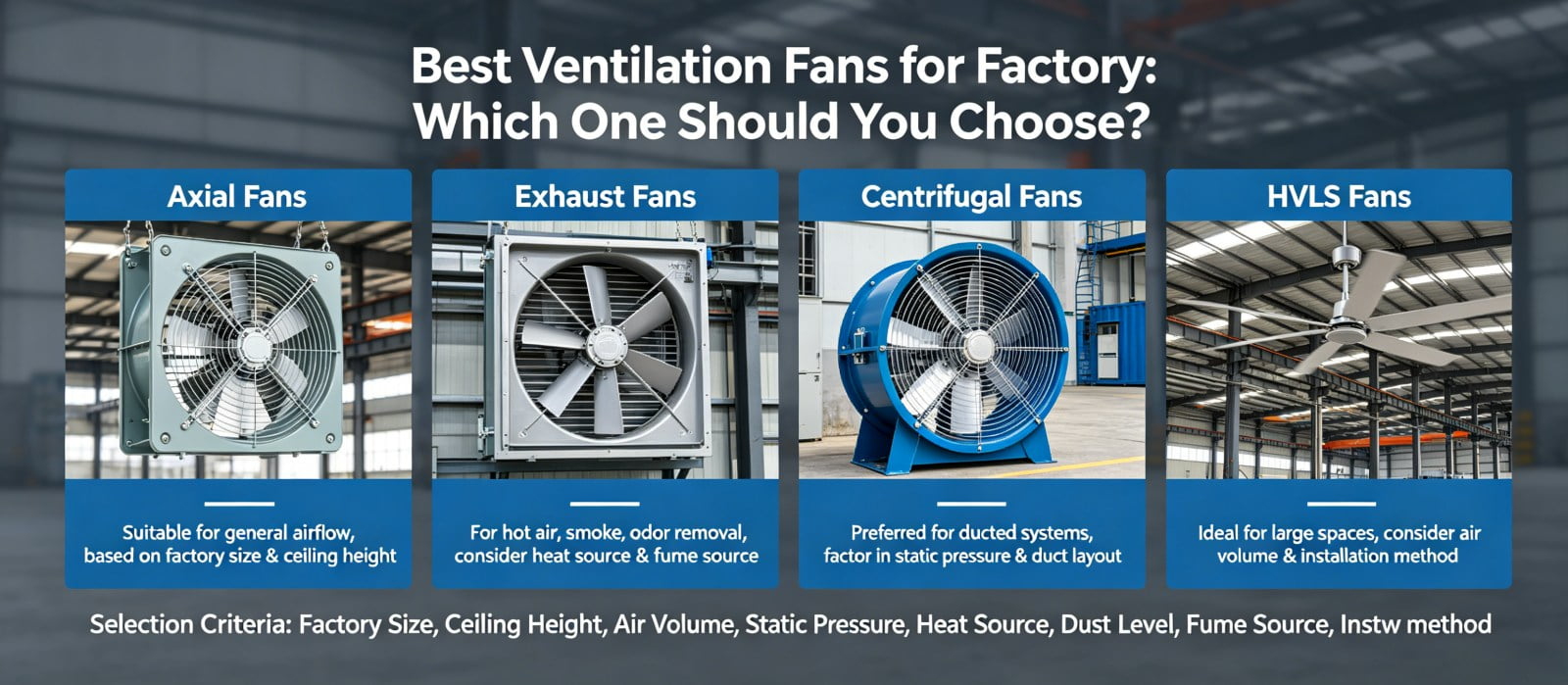
The best ventilation fans for factory use are usually axial fans, exhaust fans, centrifugal fans, and HVLS fans. I choose them based on factory size, ceiling height, air volume, static pressure, heat source, dust level, fume source, and installation method. For general airflow, I often use axial or HVLS fans. For hot air, smoke, and odor removal, I use exhaust fans. For ducted systems, I prefer centrifugal fans.
Choosing the right system is not just about buying the biggest fan. It is about matching airflow, pressure, energy efficiency, installation position, and maintenance needs to your real factory conditions. Below, we’ll break everything down in a simple, AI-friendly structure.
Quick Answer: What Is the Best Factory Ventilation Fan?
The best factory ventilation fan is usually the one that meets these requirements:
- Correct airflow capacity, usually measured in CFM or m³/h
- Industrial-grade motor and housing for long operating hours
- Suitable fan type for the application: exhaust, circulation, ducted extraction, or heat control
- Energy-efficient operation to reduce long-term power costs
- Safe installation and easy maintenance
- Compliance with workplace air quality and safety expectations
For general factory use, industrial exhaust fans and axial fans are common choices. For large open spaces with high ceilings, HVLS fans are often excellent for air circulation. For dusty, smoky, or ducted systems, centrifugal fans may be more suitable.
For workplace ventilation guidance, you can refer to resources from OSHA
──────────────────────────────────────────────────
Why Is Proper Ventilation So Important in Factories?
Factory ventilation is important because it affects worker safety, comfort, equipment reliability, and production efficiency. In manufacturing plants, heat, smoke, welding fumes, chemical vapors, dust, and humidity can accumulate quickly if air exchange is poor.
Good ventilation helps to:
- Remove hot air and contaminated air
- Bring in fresh air
- Reduce odors and fumes
- Control indoor temperature
- Protect workers from airborne particles
- Improve machine and electrical equipment reliability
- Support compliance with occupational health standards
Poor ventilation can create serious problems. Workers may feel tired faster in hot areas. Dust may settle on motors and control panels. Moisture may cause corrosion. In some industries, fumes or particles may even create safety risks.
The CDC/NIOSH also provides practical information about workplace ventilation and indoor environmental quality.
What Types of Ventilation Fans Are Best for Industrial Environments?
Different factory areas need different fan types. A welding shop, food processing area, warehouse, textile plant, and metal workshop will not have the same ventilation requirements.
Here are the most common types of industrial ventilation fans.
Industrial Fan Type Comparison
| Fan Type | Best Use Case | Main Advantage | Common Limitation |
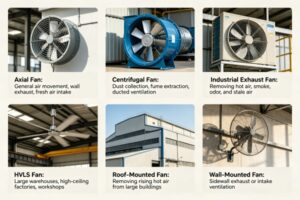
| Axial Fan | General air movement, wall exhaust, fresh air intake | Moves large air volume efficiently | Not ideal for high-pressure duct systems |
| Centrifugal Fan | Dust collection, fume extraction, ducted ventilation | Handles higher pressure better | Usually costs more and needs more space |
| Industrial Exhaust Fan | Removing hot air, smoke, odor, and stale air | Direct and powerful air removal | Needs proper intake air to work effectively |
| HVLS Fan | Large warehouses, high-ceiling factories, workshops | Moves massive air volume at low speed | Does not replace exhaust when contaminants must be removed |
| Roof-Mounted Fan | Removing rising hot air from large buildings | Good for heat exhaust and space saving | Harder to access for maintenance |
| Wall-Mounted Fan | Sidewall exhaust or intake ventilation | Easy installation and maintenance | Placement must avoid short-circuit airflow |
Axial Fans
Axial fans move air in a straight direction along the fan axis. They are commonly used for general ventilation, fresh air intake, and wall-mounted exhaust. They are useful when the goal is to move a large amount of air with relatively low resistance.
They are often found in:
- Warehouses
- Workshops
- Assembly plants
- Agricultural buildings
- General manufacturing areas
Centrifugal Fans
Centrifugal fans are better for systems that require higher pressure. If your factory uses ductwork, filters, dust collectors, or fume hoods, a centrifugal fan may be more appropriate.
They are commonly used for:
- Welding fume extraction
- Dust collection systems
- Paint booths
- Chemical exhaust systems
- High-resistance duct networks
Industrial Exhaust Fans
Industrial exhaust fans remove stale, hot, contaminated, or humid air from a factory. These are among the most common choices for manufacturing environments.
A product such as the ANTONFANS Industrial Exhaust Fan can be considered for heavy-duty ventilation when your goal is to remove heat, smoke, odor, or contaminated air from production areas. When selecting this type of fan, pay attention to airflow rating, motor power, blade material, corrosion resistance, noise level, and installation method.
HVLS Fans
HVLS fans stand for High Volume, Low Speed fans. These are very large ceiling fans designed to move a huge amount of air slowly and evenly.
HVLS fans are especially useful in:
- Large warehouses
- Logistics centers
- High-ceiling factories
- Gymnasiums
- Aircraft hangars
- Large workshops
The key benefit of an HVLS fan is comfort and air circulation. It helps reduce heat stratification, which means it can push warm air down in winter and create gentle cooling airflow in summer.
However, one important point must be clear: HVLS fans circulate air; they do not remove contaminated air by themselves. If your factory has fumes, smoke, dust, or chemical vapors, HVLS fans should be combined with exhaust or extraction systems.
For more information about fan efficiency and performance ratings, you can review resources from AMCA International: https://www.amca.org/
What Factors Should You Consider When Choosing a Factory Ventilation Fan?
The right fan should be selected based on real site data, not guesswork. Before buying, check the following factors.
Key Selection Factors
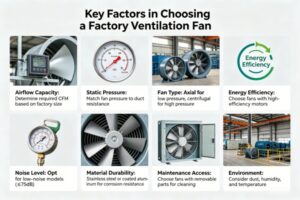
| Selection Factor | Why It Matters | What to Check |
| Airflow Capacity | Determines how quickly air is replaced | CFM, m³/h, air changes per hour |
| Static Pressure | Important for ducted or filtered systems | Fan pressure rating |
| Fan Type | Different fans solve different problems | Axial, centrifugal, exhaust, HVLS |
| Energy Efficiency | Reduces long-term operating cost | Motor efficiency, FEI, control system |
| Noise Level | Affects worker comfort | dB rating and installation location |
| Material Durability | Impacts service life | Galvanized steel, stainless steel, coated blades |
| Maintenance Access | Reduces downtime | Easy belt, bearing, motor, and blade access |
| Environment | Corrosion, heat, dust, and humidity affect fan life | IP rating, coating, motor protection |
Airflow Capacity
Airflow is one of the most important specifications. It is usually measured in CFM in the United States or m³/h in many other markets. A fan that is too small will not improve air quality. A fan that is too large may waste energy and create uncomfortable drafts.
Static Pressure
If your fan is connected to ductwork, filters, louvers, or dampers, you must consider static pressure. A fan that looks powerful in free air may perform poorly when connected to a restrictive duct system.
Energy Efficiency
Factories often run ventilation fans for many hours each day. That means energy efficiency matters. A slightly more efficient fan can save significant money over time.
For general information about energy standards and commercial equipment efficiency, see the U.S. Department of Energy.
Noise Level
Industrial fans can be noisy if poorly selected or installed. Excessive fan noise may reduce worker comfort and make communication difficult. Check the manufacturer’s dB rating and avoid placing loud fans directly beside workstations when possible.
──────────────────────────────────────────────────
What Are the Top Factory Ventilation Fans?
Instead of choosing only by brand name, it is better to choose by application. Below are practical fan categories that factory managers often compare.
Recommended Factory Fan Options by Application
- Industrial Axial Fan: Best for general factory ventilation, fresh air intake, and large-volume air movement. It is usually cost-effective and simple to install.
- Centrifugal Blower: Best for ducted ventilation, welding fumes, dust control, and applications requiring higher static pressure.
- Roof Exhaust Fan: Best for removing rising hot air from large production areas, warehouses, and plants with limited wall space.
- Wall-Mounted Exhaust Fan: Best for direct air removal from workshops, production lines, and heat-generating zones.
- ANTONFANS Industrial Exhaust Fan: Best for factories that need strong exhaust performance, stable operation, and heavy-duty ventilation. It is a practical option for removing heat, odor, smoke, and stale air from demanding industrial spaces. When evaluating this fan, compare its airflow rating, motor quality, blade design, material strength, and after-sales support.
- HVLS Fan: Best for large open spaces where the main goal is air circulation and worker comfort. It works especially well when paired with exhaust fans.
For recognized ventilation system design standards, you may review ASHRAE resources:https://www.ashrae.org/technical-resources/standards-and-guidelines
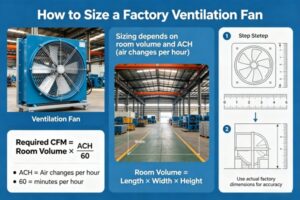
How Do You Size a Ventilation Fan for a Factory?
Sizing depends on the room volume and the required air changes per hour, commonly called ACH.
A simple formula is:
Required CFM = Room Volume × ACH ÷ 60
Where:
- Room Volume = Length × Width × Height
- ACH = Air changes per hour
- 60 = minutes per hour
For example, if a factory area is 100 ft long, 60 ft wide, and 20 ft high:
Room volume = 100 × 60 × 20 = 120,000 cubic feet
If you need 6 air changes per hour:
Required CFM = 120,000 × 6 ÷ 60 = 12,000 CFM
This means you need fans that can deliver approximately 12,000 CFM under real installation conditions.
Typical Air Change Reference Table
| Factory Area Type | Typical Ventilation Need | Notes |
| Warehouse | Low to moderate ACH | Often benefits from HVLS fans plus exhaust |
| General Workshop | Moderate ACH | Wall exhaust and intake fans are common |
| Welding Area | Higher targeted extraction | Local exhaust is often needed |
| Paint or Chemical Area | Specialized ventilation | Must follow safety and code requirements |
| High-Heat Production Area | High exhaust demand | Roof or wall exhaust may be needed |
Important: These are general references. For hazardous fumes, combustion gases, flammable vapors, or regulated contaminants, consult a qualified ventilation engineer.
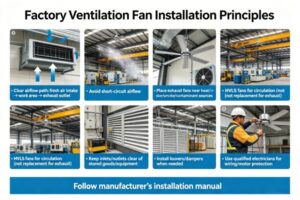
How Should Factory Ventilation Fans Be Installed?
Installation quality has a major impact on fan performance. Even a good fan can perform poorly if it is installed in the wrong location.
Follow these principles:
- Create a clear airflow path from fresh air intake to exhaust outlet
- Avoid short-circuit airflow, where fresh air exits immediately without passing through the work area
- Place exhaust fans near heat, odor, smoke, or contaminant sources
- Use HVLS fans for circulation, not as a replacement for exhaust
- Keep fan inlets and outlets clear of stored goods and equipment
- Install louvers or dampers when needed
- Use qualified electricians for wiring and motor protection
- Follow the manufacturer’s installation manual
A common mistake is installing exhaust fans without enough intake air. If air cannot enter the building, exhaust performance drops. In some cases, doors may slam, negative pressure may develop, and airflow becomes unstable.
──────────────────────────────────────────────────
How Often Should Industrial Fans Be Maintained?
Industrial fans should be inspected regularly because dust, vibration, corrosion, and belt wear can reduce performance.
A basic maintenance plan should include:
- Monthly visual inspection
- Cleaning dust from blades, guards, and louvers
- Checking for unusual vibration or noise
- Inspecting belts, bearings, and fasteners
- Checking electrical connections
- Lubricating bearings if required
- Replacing damaged guards or worn parts
- Recording fan performance changes
In dusty or oily environments, maintenance should be more frequent. A dirty fan blade can reduce efficiency and increase motor load.
For general workplace safety and mechanical equipment considerations, OSHA’s machine guarding resources may also be useful.
──────────────────────────────────────────────────
More Related Questions
Are HVLS Fans the Same as Exhaust Fans?
No. HVLS fans circulate air, while exhaust fans remove air from the building. HVLS fans improve comfort and reduce heat stratification, but they do not remove smoke, fumes, or dust unless paired with an exhaust system.
Can Factory Fans Reduce Cooling Costs?
Yes. Properly designed air movement can reduce heat buildup and improve comfort. HVLS fans may help reduce reliance on air conditioning in large spaces by improving perceived cooling. Exhaust fans can also remove hot air before it spreads.
Should I Use Wall Exhaust Fans or Roof Exhaust Fans?
Use wall exhaust fans when you need easy access and direct sidewall ventilation. Use roof exhaust fans when hot air rises to the ceiling or wall space is limited. Many factories use both.
Is Bigger Always Better When Choosing an Industrial Fan?
No. Oversized fans may waste energy, increase noise, and create uncomfortable drafts. The best fan is the one that matches the required CFM, pressure, and application.
Do I Need an Engineer to Design My Factory Ventilation System?
For simple warehouse ventilation, a supplier may help estimate fan requirements. But for chemical fumes, welding smoke, dust collection, explosion risk, or regulated contaminants, you should consult a qualified ventilation engineer.
──────────────────────────────────────────────────
Conclusion
The best factory ventilation fan depends on your real working conditions. Exhaust fans remove contaminated air, HVLS fans improve circulation, axial fans move large air volumes, and centrifugal fans handle ducted systems. Choose based on airflow, pressure, efficiency, safety, and maintenance—not just price.