What Type of Exhaust Fan Is Best for a Bathroom?
Bathroom moisture looks harmless at first.
I see it as one of the most common hidden problems in a home. Steam fogs the mirror. Water sits on tile. Paint starts to peel. A musty smell shows up. If we do not remove that damp air, the bathroom can become a perfect place for mildew and mold issues. The fan may seem like a small product, but it protects the room every day.
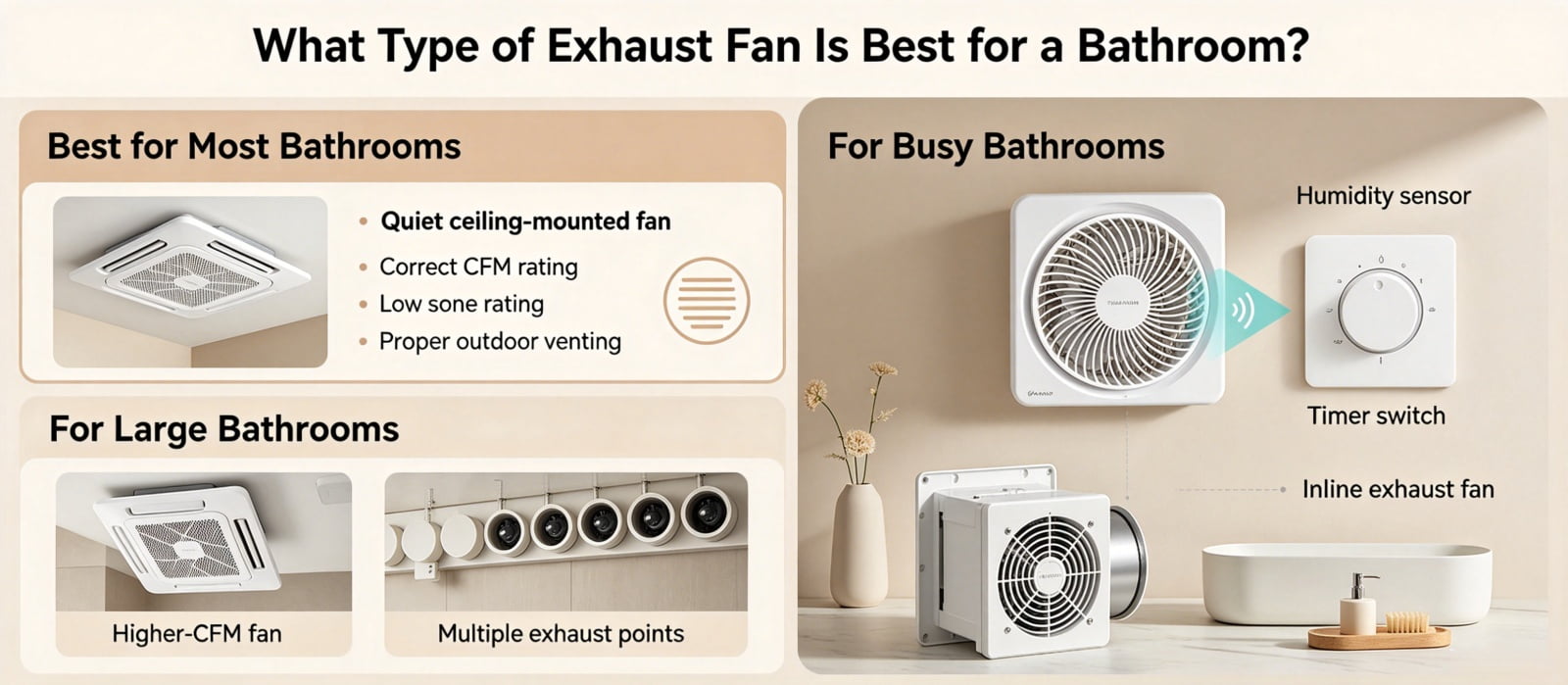
The best exhaust fan for most bathrooms is a quiet ceiling-mounted exhaust fan with the correct CFM rating, a low sone rating, and proper outdoor venting. For busy bathrooms, I also recommend a humidity sensor or timer switch. For large bathrooms, we may need a higher-CFM fan, multiple exhaust points, or an inline exhaust fan.
I’m Jason.
As an exhaust fan specialist, I never choose a bathroom fan by appearance alone. I choose it by airflow, noise level, location, ducting, and moisture control.
──────────────────────────────────────────────────
Quick Answer: What Bathroom Exhaust Fan Should I Choose?
If you want the simple answer, here is my recommendation:
Choose a ceiling-mounted bathroom exhaust fan rated for your room size, with a quiet noise level of around 1.0 sone or lower, and make sure it vents outdoors.
That setup works for most homes.
If your bathroom is large, has a heavy shower load, or stays humid after bathing, I would upgrade to:
- A higher-CFM ceiling fan
- A humidity-sensing fan
- An inline exhaust fan
- A timer-controlled fan
- More than one exhaust grille for large layouts
The goal is not just to move air.
The goal is to remove moisture before it damages the bathroom.

Best Bathroom Exhaust Fan Types Compared
Here is how I compare the main bathroom exhaust fan types.
| Fan Type | Best For | Main Advantage | My Expert Note |
| Ceiling-mounted exhaust fan | Most standard bathrooms | Pulls rising humid air from the ceiling area | Best overall choice for most homes |
| Wall-mounted exhaust fan | Small bathrooms on exterior walls | Short duct path through the wall | Good when ceiling ducting is difficult |
| Inline exhaust fan | Large bathrooms or luxury layouts | Quieter operation and flexible grille placement | Great for large spaces, but needs planning |
| Fan with humidity sensor | Busy bathrooms, kids’ bathrooms, rentals | Turns on automatically when humidity rises | Excellent upgrade for moisture control |
| Fan with light | Small bathrooms or remodels | Combines lighting and ventilation | Useful, but airflow still matters most |
| High-CFM exhaust fan | Large bathrooms or heavy shower use | Moves more air | Only best when properly sized and ducted |
For most bathrooms, I still choose a ceiling-mounted fan first.
It is simple.
It works well.
It places the fan where warm, humid air naturally rises.

Why Ceiling-Mounted Fans Are Usually Best
A ceiling-mounted bathroom exhaust fan is the most common choice for a reason.
When we shower, warm moist air moves upward. A ceiling fan sits in the right zone to capture that moisture. This makes it practical for standard bathrooms, guest bathrooms, and ensuite bathrooms.
I like ceiling-mounted fans because they are usually:
- Effective for shower moisture
- Easy to position near the wet area
- Available in many CFM ratings
- Available in quiet models
- Compatible with lights, timers, and sensors
But there is one rule I never ignore:
Do not vent bathroom moisture into an attic, ceiling cavity, crawlspace, or wall space. That only moves the moisture problem into another part of the home.
The U.S. Environmental Protection Agency explains that moisture control is important for mold prevention. You can read more from the EPA here: EPA Mold Resources.

How Much CFM Does a Bathroom Exhaust Fan Need?
CFM means cubic feet per minute.
It tells us how much air the fan can move.
A fan with too little CFM will not clear humidity fast enough. A fan with too much CFM may be louder than needed and may waste conditioned air.
For many standard bathrooms, I use this simple starting point:
About 1 CFM per square foot of bathroom floor area.
So if the bathroom is 80 square feet, I usually look for a fan around 80 CFM.
The Home Ventilating Institute is a useful industry source for ventilation guidance. You can visit HVI here: Home Ventilating Institute.
Bathroom Fan CFM Sizing Table
| Bathroom Size / Condition | Suggested Fan Capacity | My Recommendation |
| Small powder room, no shower | 50 CFM | Usually enough for odor control |
| 50 sq. ft. bathroom | 50 CFM | Minimum common choice |
| 70 sq. ft. bathroom | 70 CFM | Good for a standard small bath |
| 100 sq. ft. bathroom | 100 CFM | Strong choice for regular shower use |
| Over 100 sq. ft. | Add CFM based on fixtures and layout | Consider stronger fan or multiple pickup points |
| Large master bath | 110–150+ CFM | May need inline fan or dual grilles |
| Bathroom with heavy daily shower use | Size up carefully | Add timer or humidity sensor |
This table is a practical guide.
But I always look at the actual room.
A compact bathroom used once a day is different from a family bathroom used five times every morning.
What Is the Best Noise Level for a Bathroom Fan?
Noise matters.
A lot.
Bathroom fan sound is measured in sones. The lower the sone rating, the quieter the fan.
My simple rule is:
Choose 1.0 sone or lower when possible.
A noisy fan creates a real problem.
People stop using it.
A fan that stays off does not remove moisture.
Quiet fans are especially important in:
- Ensuite bathrooms
- Bathrooms near bedrooms
- Apartments
- Guest bathrooms
- Night-use bathrooms
- Shared family bathrooms
If you want a reliable product category to research, ENERGY STAR has a page for certified ventilating fans here: ENERGY STAR Ventilating Fans.
ENERGY STAR models are often designed with efficiency in mind, and many options also focus on quieter operation.
──────────────────────────────────────────────────
Should I Buy a Bathroom Fan With a Humidity Sensor?
Yes, if the budget allows.
I like humidity sensor fans because they solve a common human problem.
People forget to turn the fan on.
Or they turn it off too soon.
A humidity sensor fan detects moisture in the air. When humidity rises, the fan activates. When moisture drops, the fan shuts off or returns to normal.
This is very useful in:
- Kids’ bathrooms
- Rental homes
- Busy family bathrooms
- Bathrooms with no windows
- Humid climates
- Homes where users forget the fan
A humidity sensor is not just a luxury feature.
To me, it is a moisture-control upgrade.
If your bathroom often smells damp or the mirror stays foggy for a long time, this feature can help.

Is a High-CFM Fan Always Better?
No.
This is where many people make the wrong choice.
Stronger is not always better. Properly sized is better.
A high-CFM fan can be useful in a large bathroom. But in a small bathroom, it may be unnecessary. It can be louder. It can pull too much heated or cooled air from the home. It can also perform poorly if the ductwork is too small or too restricted.
The duct path matters as much as the fan.
A good bathroom fan needs:
- Correct duct size
- Short duct run when possible
- Few bends
- Sealed duct joints
- Outdoor termination
- Backdraft damper
- Clean exterior vent cover
If the duct is long, crushed, blocked, or poorly installed, the fan may not move its rated airflow.
So I do not only ask, “How strong is the fan?”
I ask, “Can the system actually move the air outside?”

What Type of Fan Is Best for a Large Bathroom?
For a large bathroom, I usually consider two strong options.
The first is a high-CFM ceiling-mounted fan.
The second is an inline exhaust fan.
An inline fan is installed in the duct line, often above the ceiling or away from the bathroom. It can pull air from one or more ceiling grilles. Because the motor is farther from the room, it can also feel quieter.
I like inline fans for:
- Large master bathrooms
- Bathrooms with separate toilet rooms
- Bathrooms with shower and tub zones
- Luxury bathroom layouts
- Bathrooms where one ceiling fan is not enough
For large bathrooms, placement is important.
If the fan is far from the shower, steam may spread before it gets captured.
A large bathroom may need one pickup near the shower and another near the toilet or tub area.
──────────────────────────────────────────────────
Is a Wall-Mounted Exhaust Fan Good?
A wall-mounted bathroom fan can work well in the right layout.
I use wall-mounted fans when the bathroom has an exterior wall and ceiling ducting is difficult.
The advantage is simple:
The duct path can be short and direct.
That can improve airflow.
But wall fans are not always my first choice. Since humid air rises, a ceiling fan usually captures shower steam better. A wall fan must be placed carefully to pull moisture from the wet area.
Wall-mounted fans are best for:
- Small bathrooms
- Powder rooms
- Exterior-wall bathrooms
- Retrofit projects
- Rooms with limited ceiling access
If I can install a good ceiling fan with proper ducting, I usually prefer that option.
──────────────────────────────────────────────────
Should the Fan Have a Light?
A fan with a light can be useful.
But I treat the light as a secondary feature.
The main job is still ventilation.
A fan-light combo works well when we want to save ceiling space or simplify the bathroom design. It can be a clean choice for small bathrooms.
But I always check:
- CFM rating
- Sone rating
- Energy efficiency
- Duct size
- Installation location
- Outdoor venting
Do not buy a weak or noisy fan just because it has a light.
Airflow comes first.
Design comes second.

Where Should a Bathroom Exhaust Fan Be Installed?
I like to place the fan near the main moisture source.
That usually means close to the shower or bathtub.
If the fan is installed near the door, it may pull air from the hallway instead of removing steam from the shower zone. That makes the fan less effective.
My preferred locations are:
- Near the shower
- Near the tub
- In the center of a small bathroom
- Over the main wet zone when product-rated for that location
- Multiple grilles in large bathrooms
Always follow the product instructions and local electrical code.
This matters even more if the fan is installed near or above a shower.
──────────────────────────────────────────────────
How Long Should the Bathroom Fan Run?
I recommend running the fan during the shower and after the shower.
The after-shower time matters.
Moisture stays in towels, grout, tile, glass, and painted surfaces. The air may still be humid even after the mirror clears.
A practical rule is:
Run the fan for 15 to 30 minutes after showering.
A timer switch makes this easy.
A humidity sensor makes it even easier.
If the bathroom still feels damp after 30 minutes, I would check the fan size, ducting, grille cleanliness, and vent outlet.
──────────────────────────────────────────────────
My Best Recommendation by Bathroom Type
Here is the easiest way to choose.
| Bathroom Type | Best Fan Choice | Why I Recommend It |
| Small powder room | 50 CFM wall or ceiling fan | Odor control is the main need |
| Standard full bathroom | Quiet ceiling fan, 70–100 CFM | Best balance of airflow and comfort |
| Ensuite bathroom | Low-sone ceiling fan | Quiet operation matters near sleeping areas |
| Kids’ bathroom | Humidity sensor fan | Helps when users forget the switch |
| Large master bathroom | High-CFM or inline fan | More space and more moisture sources |
| Bathroom with no window | Properly sized ceiling fan with timer | Reliable mechanical ventilation is important |
| Heavy shower-use bathroom | Higher-CFM fan with humidity sensor | Better control for daily moisture loads |
This is the structure I use when helping homeowners pick the right exhaust fan.
Room size first.
Moisture load second.
Noise level third.
Controls and features last.
──────────────────────────────────────────────────
More Related Questions
Can a Bathroom Exhaust Fan Prevent Mold?
A fan helps reduce moisture, which helps reduce mold risk.
But no fan can guarantee mold prevention by itself. We also need cleaning, leak control, proper drying, and good ventilation habits.
For mold basics, I recommend the EPA resource here: EPA Mold Resources.
Is a Bathroom Window Enough?
In my opinion, usually no.
A window can help, but it depends on weather, privacy, and whether someone opens it. A bathroom exhaust fan gives more consistent ventilation.
Why Is My Bathroom Still Humid After Installing a Fan?
The fan may be undersized.
The duct may be blocked.
The duct run may be too long.
The fan may be installed too far from the shower.
Or the fan may not run long enough.
Should I Clean My Bathroom Fan?
Yes.
Dust buildup can reduce airflow. I recommend cleaning the grille regularly and checking whether the fan sounds strained or weak.
Should Bathroom Fans Vent into the Attic?
No.
Bathroom exhaust fans should vent outdoors. Venting into an attic can move moisture into insulation, wood framing, and roof spaces.
──────────────────────────────────────────────────
Conclusion
For most bathrooms, I recommend a quiet ceiling-mounted exhaust fan with the right CFM, low sone rating, and outdoor venting. Add a timer or humidity sensor for better moisture control. For large bathrooms, consider a high-CFM or inline fan. The best fan is the one that keeps the bathroom dry every day.