.jpg)
Choosing the wrong axial fan size causes problems fast. I have seen rooms stay hot even after a new fan was installed. I have seen workshops stay dusty because the airflow was too weak. I have also seen oversized fans create noise, drafts, and wasted energy. The fan was not always bad. The sizing was bad. If we do not match airflow, static pressure, fan curve, noise, and installation space, the ventilation system will not work as expected.
To choose the right size axial fan, I calculate the required airflow first. Then I check the system static pressure. After that, I match both values with the axial fan curve. I also confirm the fan diameter, motor power, voltage, noise level, airflow direction, and mounting space. In my view, the right axial fan is not the biggest fan. It is the fan that delivers the required airflow under real operating conditions.
I am Jason. As an axial fan specialist, I like to keep sizing simple, but not careless. Below is the process I use when selecting axial fans for general ventilation, workshops, warehouses, equipment rooms, and ducted ventilation systems.
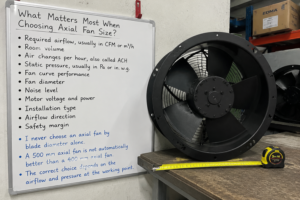
Quick Answer: What Matters Most When Choosing Axial Fan Size?
The right axial fan size depends on these main factors:
- Required airflow, usually in CFM or m³/h
- Room volume
- Air changes per hour, also called ACH
- Static pressure, usually in Pa or in. w.g.
- Fan curve performance
- Fan diameter
- Noise level
- Motor voltage and power
- Installation type
- Airflow direction
- Safety margin
I never choose an axial fan by blade diameter alone.
A 500 mm axial fan is not automatically better than a 400 mm axial fan.
The correct choice depends on the airflow and pressure at the working point.

Step 1: Define The Ventilation Purpose
Before I calculate anything, I ask one question.
What problem are we solving?
Different ventilation goals need different airflow levels.
We may need to remove:
- Heat
- Moisture
- Smoke
- Fumes
- Dust
- Odors
- Stale air
A warehouse may only need general air exchange.
A machine room may need heat removal.
A workshop may need stronger airflow to control dust or fumes.
A greenhouse may need temperature and humidity control.
This first step matters because the fan size must match the job.
For general ventilation guidance, I like resources from organizations such as OSHA’s ventilation overview and the Canadian Centre for Occupational Health and Safety ventilation guide.

Step 2: Calculate Room Volume
The next step is simple.
I calculate the room volume.
For a rectangular room:
Room Volume = Length × Width × Height
If I use metric units:
Room Volume = m³
If I use imperial units:
Room Volume = ft³
Example:
A room is:
- 10 meters long
- 6 meters wide
- 4 meters high
So the volume is:
10 × 6 × 4 = 240 m³
This number is the base for airflow calculation.
Without the room volume, we are only guessing.
Step 3: Choose The Right Air Changes Per Hour
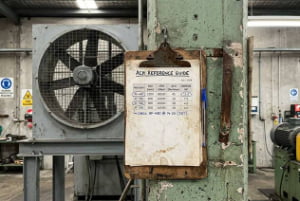
Air changes per hour means how many times the air in a room is replaced in one hour.
It is often written as ACH.
For example:
- 5 ACH means the full room air volume is replaced 5 times per hour.
- 10 ACH means the full room air volume is replaced 10 times per hour.
The right ACH depends on the application.
Below is a simple reference table.
| Application Type | Typical Ventilation Need | Common ACH Range |
| Storage room | Low air exchange | 2–6 ACH |
| Office or light commercial room | Comfort ventilation | 4–8 ACH |
| Workshop | Heat, dust, or odor control | 6–12 ACH |
| Equipment room | Heat removal | 8–20 ACH |
| Industrial process area | Higher contaminant control | 10+ ACH, depending on process |
These are general starting points.
I still check the real site conditions.
For more reference data, I often use the Engineering ToolBox air change rate table. For formal indoor ventilation design, I also recommend checking ASHRAE Standard 62.1 and 62.2.
Step 4: Calculate Required Airflow
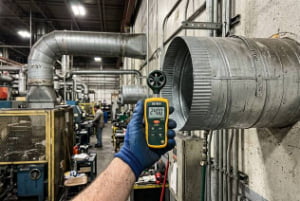
Once I know the room volume and ACH, I calculate airflow.
The metric formula is:
Airflow in m³/h = Room Volume in m³ × ACH
The imperial formula is:
CFM = Room Volume in ft³ × ACH ÷ 60
Let me use the earlier room example.
Room volume:
240 m³
Required air changes:
10 ACH
Required airflow:
240 × 10 = 2,400 m³/h
So I need a fan that can deliver about 2,400 m³/h.
But this is not the final fan selection.
It is only the airflow target.
Now I need to check static pressure.
Step 5: Check Static Pressure
This is where many fan selections go wrong.
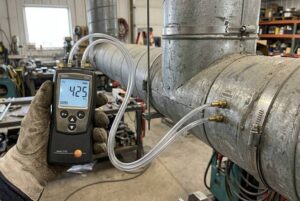
Static pressure is the resistance the fan must overcome.
Air does not move through a system without resistance.
Every part of the system adds pressure loss.
Common resistance sources include:
- Ducts
- Elbows
- Filters
- Guards
- Louvers
- Backdraft dampers
- Silencers
- Screens
- Poor inlet clearance
- Small outlet openings
An axial fan may deliver strong airflow in free air.
But if we install it behind a filter or inside a duct system, the airflow can drop.
This is why I do not trust free-air airflow alone.
I want to know the airflow at the required static pressure.
For duct pressure loss basics, a useful technical reference is the Engineering ToolBox duct friction and pressure loss guide.
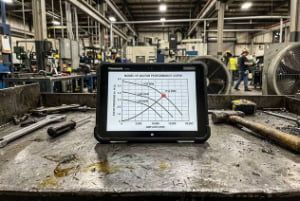
Step 6: Match The Fan Curve
The fan curve is one of the most important documents in axial fan selection.
A fan curve shows how much airflow the fan can deliver at different pressure levels.
I look for the working point.
The working point is where:
Required airflow meets required static pressure.
For example:
If the system needs:
- 2,400 m³/h
- 80 Pa static pressure
Then I need an axial fan that can deliver:
2,400 m³/h at 80 Pa
Not 2,400 m³/h at 0 Pa.
Not 80 Pa at very low airflow.
Both values must match at the same time.
I also prefer the fan to operate near the middle of its curve.
If the fan works too close to the limit, it may become:
- Noisy
- Inefficient
- Unstable
- Shorter-lived
This is why I always check performance curves before confirming fan size.
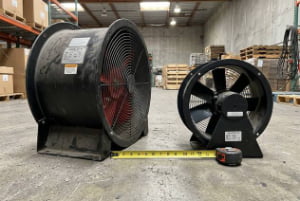
Step 7: Choose Fan Diameter Carefully
Fan diameter matters.
But diameter alone does not decide the correct size.
A larger axial fan can usually move more air at a lower speed.
That often means:
- Lower noise
- Better efficiency
- Less vibration
- Longer service life
A smaller fan may need higher RPM to move the same airflow.
That can increase noise and power use.
However, two fans with the same diameter can perform very differently.
Performance depends on:
- Blade angle
- Blade shape
- Motor speed
- Hub size
- Casing design
- Motor power
- Airfoil design
So when someone asks me, “What diameter axial fan do I need?” I usually answer with airflow and pressure first.
Then I confirm diameter.
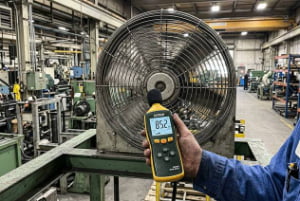
Step 8: Review Noise Limits
Noise is not just a comfort issue.
It can decide whether the installation is accepted or rejected.
Axial fan noise can come from:
- High blade speed
- Turbulent inlet air
- Restricted outlet
- Vibration
- Motor noise
- Poor mounting
- Duct resonance
If the fan is used in an industrial workshop, a higher sound level may be acceptable.
If the fan is used near offices, stores, schools, or public areas, I choose more carefully.
Sometimes I select a larger fan at lower speed.
This can reduce sound while keeping airflow strong.
For workplace noise exposure limits, I recommend checking OSHA occupational noise exposure information.

Step 9: Confirm Installation Space
A good fan can perform badly if the installation is poor.
So I always check the physical space.
Here is my practical sizing checklist.
| Item To Check | Why It Matters | My Recommendation |
| Wall or duct opening | Fan must fit correctly | Measure before selection |
| Inlet clearance | Blocked inlet reduces airflow | Keep inlet open and smooth |
| Outlet clearance | Restricted outlet raises pressure | Avoid tight discharge spaces |
| Duct size | Small ducts increase resistance | Match duct and fan size when possible |
| Filters or louvers | They add pressure loss | Include them in static pressure |
| Mounting surface | Weak panels cause vibration | Use strong supports |
| Service access | Maintenance affects long-term airflow | Leave space for cleaning |
| Airflow direction | Supply and exhaust are different | Confirm direction before ordering |
This table may look basic.
But these details prevent many real problems.
I have seen fans selected correctly on paper, then installed too close to a wall or elbow.
The result was poor airflow and high noise.
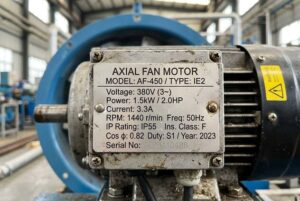
Step 10: Check Motor Power And Electrical Details
The motor must match both the fan duty and the site power supply.
I check:
- Voltage
- Phase
- Frequency
- Motor power
- Speed
- Insulation class
- IP protection rating
- Duty cycle
- Temperature rating
- Speed control compatibility
A motor that is too weak can overheat.
A motor that is too large may cost more than needed.
If the fan will run continuously, efficiency becomes important.
Long operating hours can make a small energy difference significant over time.
I also consider whether the user needs speed control.
Not every motor works with every controller.
So I confirm this before the fan is installed.

Step 11: Add A Reasonable Safety Margin
I usually add a safety margin.
But I do not oversize blindly.
A reasonable safety margin helps cover:
- Dirty filters
- Minor duct changes
- Aging components
- Installation losses
- Future ventilation demand
For many general applications, I may allow around 10% to 20% extra capacity.
But I stay careful.
Too much oversizing can cause:
- High noise
- Uncomfortable drafts
- Higher energy use
- Negative pressure problems
- Poor system balance
My rule is simple.
Add enough margin to protect performance. Do not add so much that the system becomes wasteful.
Common Mistakes When Choosing Axial Fan Size
I see these mistakes often.
They are easy to avoid.
Choosing Only By Diameter
This is the most common mistake.
A fan diameter does not tell the full story.
We need airflow and pressure performance.
Ignoring Static Pressure
This mistake causes weak airflow after installation.
Filters, ducts, louvers, and bends all matter.
Using Free-Air Airflow Only
Free-air airflow is measured with little or no resistance.
Real systems often have resistance.
So I always check airflow at static pressure.
Oversizing The Fan
Bigger is not always better.
An oversized fan can create noise and waste energy.
Forgetting Noise
A fan that moves enough air can still be unsuitable if it is too loud.
Ignoring Maintenance
Dirty guards, blocked filters, and dusty blades reduce airflow.
A fan system must be maintained.

Simple Axial Fan Sizing Formula Summary
Here is the short version I use.
- Measure the room.
- Calculate room volume.
- Choose the required ACH.
- Calculate airflow.
- Estimate static pressure.
- Check the fan curve.
- Confirm fan diameter and installation space.
- Check noise level.
- Confirm motor power and voltage.
- Add a small safety margin.
For metric airflow:
m³/h = Room Volume × ACH
For imperial airflow:
CFM = Room Volume × ACH ÷ 60
This gives us a starting point.
The final choice still depends on the fan curve.
──────────────────────────────────────────────────
More Related Questions
Can An Axial Fan Be Too Small?
Yes.
If the axial fan is too small, it will not remove enough heat, moisture, dust, fumes, or stale air.
The room may stay uncomfortable.
The motor may run continuously.
The system may never meet the ventilation goal.
Can An Axial Fan Be Too Big?
Yes.
An oversized axial fan can create too much noise, too much draft, and unnecessary energy cost.
It may also disturb building pressure balance.
Correct sizing is better than oversizing.
Is An Axial Fan Good For Ducted Ventilation?
Yes, but only when the duct resistance is suitable.
Axial fans are best for high airflow and low to medium pressure.
If the duct system has long runs, many elbows, or dense filters, I check the static pressure very carefully.
Should I Use A High-Speed Or Low-Speed Axial Fan?
It depends on the airflow, pressure, space, and noise limit.
A high-speed fan may fit a smaller opening.
A low-speed fan may be quieter.
I choose based on the full working condition.
How Often Should I Inspect The Fan?
I recommend regular inspection.
Dust buildup, dirty guards, damaged blades, and worn bearings can reduce performance.
Even a correctly sized fan needs maintenance.
──────────────────────────────────────────────────
Conclusion
I choose the right axial fan by matching airflow, static pressure, fan curve, diameter, noise, motor power, and installation space. Diameter matters, but real performance matters more. When we size the fan around actual working conditions, the ventilation system becomes safer, quieter, and more reliable.