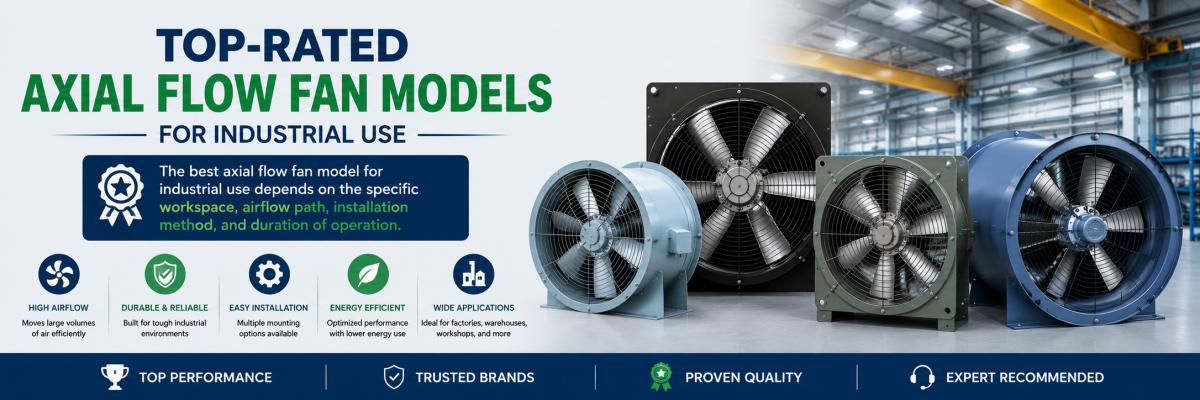
Heavy-duty factories and warehouses often struggle with inefficient airflow, excess heat, or poor ventilation. Picking the wrong axial flow fan can cost more than money—it can impact onsite safety and comfort.1
The best axial flow fan model for industrial use depends on the specific workspace, airflow path, installation method, and duration of operation.2 Buyers must match the fan to their environment to avoid underperformance or overspending.
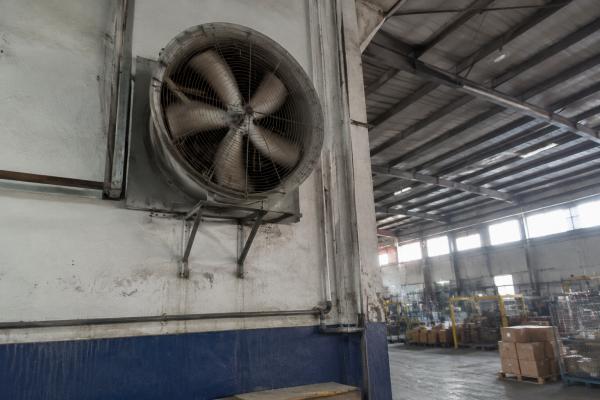
Many buyers search for “top-rated” fans by scanning lists or rankings. But in my experience as a fan manufacturer, lists rarely deliver meaningful answers. The real question is about fit: which configuration matches the site’s airflow demands, and which fan structure offers critical reliability?
Why Aren’t All “Top-Rated” Axial Flow Fans the Same for Industrial Use?
Many buyers believe the highest-rated fan model will handle any job. That is a mistake. Different workspaces need different fan designs.3
Ranking axial flow fans without considering airflow direction, pressure demands, heat, project purpose, or installation position can lead to disappointment.4 There is no universal “top-rated” fan—each environment has unique needs.
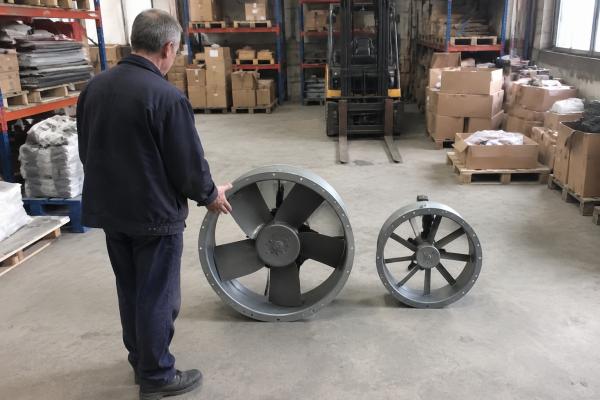
I have seen warehouse buyers select high airflow fans for general ventilation, only to find they lack enough static pressure for duct runs. In contrast, factories focused on cooling equipment require targeted airflow at specific points. For exhaust duty, fans must move air efficiently through walls or ducts. The parameters below guide the right model selection:
| Application | Typical Fan Design | Key Selection Features |
|---|---|---|
| Factory Floor | Direct axial flow | High airflow, robust motor, low noise |
| Warehouse Venting | Wall-mounted axial | Large diameter, high-pressure fans |
| Equipment Cooling | Compact axial | Localized airflow, durable bearings |
| Heat Exhaust | Ducted axial | High static pressure, corrosion-proof |
| General Vent | Ceiling/wall axial | Energy-efficient, easy installation |
A warehouse may need a wall-mounted axial fan with reinforced blades. An engineering contractor might specify duct-mounted models with sealed motors for a dusty site. The “top-rated” fan is always the one that meets the application’s need.
Does High Airflow Volume Guarantee Performance in Industrial Spaces?
Many buyers believe airflow volume is the most important parameter. But focusing only on airflow misses key performance factors.
A fan’s performance depends not just on airflow volume, but also on static pressure, exhaust path, noise, power, operating hours, and physical size.5 Matching all these factors ensures the fan delivers reliable, efficient air movement for the site’s demands.
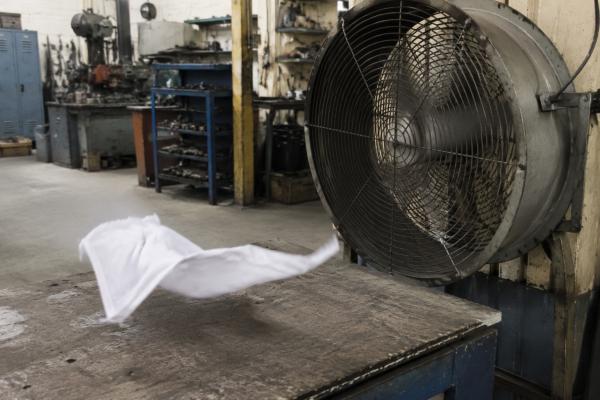
For example, I have seen users install large-diameter fans with high airflow numbers in environments with long, narrow exhaust ducts. Their airflow drops sharply6 because the fan cannot push air against enough resistance. Instead, fans with higher static pressure, blade design, or motor strength work better in those cases.
Let’s break this down:
Key Fan Parameters and Field Impact
| Parameter | Field Effect |
|---|---|
| Airflow volume | Overall capacity, but drops in high resistance |
| Static pressure | Enables airflow through ducts or filters |
| Noise level | Important for worker comfort and compliance |
| Power rating | Affects energy cost and efficiency |
| Installation | Impacts how air is distributed on site |
| Continuous duty | Determines fan’s suitability for 24-hr use |
A fan rated for high airflow may fail to ventilate effectively if the static pressure is too low for the system. Noise is also critical where workers must concentrate. That is why I always tell customers to start with their installation conditions, then build up their specification needs.
What Makes Axial Flow Fans Last? Structure, Motor, and Production Consistency
Low upfront price and high CFM numbers are not everything. Long-term reliability comes from structure, motor quality, blade design, housing protection, and production consistency.7
Durability is built into every detail. For harsh environments, I use corrosion-resistant materials, reinforced housing, sealed bearings, and temperature-rated motors. Internal testing checks vibration, temperature rise, noise, and performance under continuous duty cycles.
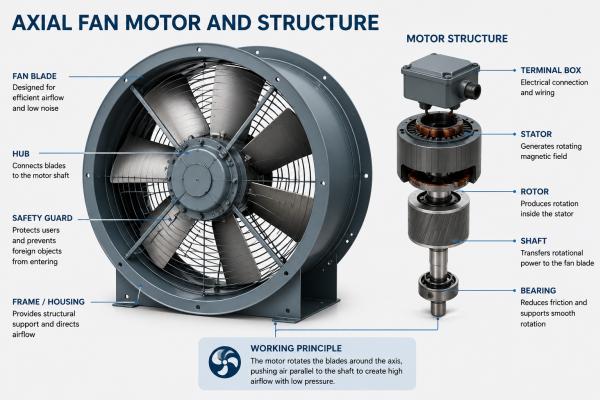
Many industrial buyers underestimate how small differences in model construction affect service life. A fan used in a hot, dusty warehouse needs dust-proof bearings and sealed motor housings.8 If installed near corrosive fumes, the blade and housing need chemical-resistant coatings.9 Consistent mass production under controlled QC ensures every unit meets the same standards.
Core Features for Durability
| Component | Impact on Reliability |
|---|---|
| Motor | Heat and dust resistance, high duty cycles |
| Bearing | Vibration tolerance, lifespan |
| Blade | Balance, corrosion resistance |
| Housing | Strength, environmental protection |
| QC process | Unit-to-unit consistency in production |
With the ANTONFANS automated system and strict QC, I know every batch performs reliably in every environment. Investing upfront in structure and testing avoids breakdowns and saves money over the product life.
How to Avoid Over-Spec and Under-Spec Fan Selection Mistakes?
It is easy to choose a fan model based on maximum numbers. But fans that are too small or too large often fail.
An undersized fan cannot move enough air, leading to heat buildup, poor ventilation, or employee complaints. An oversized fan may cause excess noise, energy waste, vibration, and budget overruns. Both mistakes stem from ignoring the real site’s airflow path, duty cycle, or installation position.
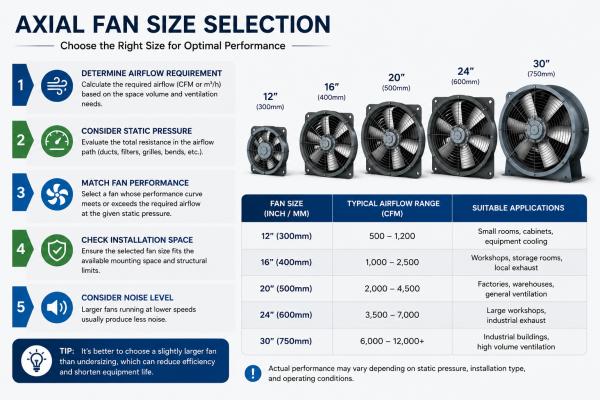
From my experience, buyers get the best result by sharing their space size, purpose, installation method, airflow goal, and hours of operation. This lets the manufacturer recommend a model that balances performance, reliability, and cost.
Common Scenario Breakdown
| Error Type | Outcome | Example Solution |
|---|---|---|
| Under-spec | Poor ventilation, heat buildup | Upgrade motor, larger blade diameter |
| Over-spec | Noise, energy waste | Downsize, optimize for air path/resistance |
| Wrong install | Vibration, poor air movement | Adjust mounting, select with correct housing |
| Wrong duty | Motor overheating, breakdown | Specify for continuous use, sealed motor |
I encourage buyers to ask for reviews of onsite duty cycles and installation before making final selections. Matching the fan to actual conditions unlocks reliable performance and avoids common mistakes.
Conclusion
No single axial flow fan model is best for every industrial use. Share your site conditions, airflow need, and installation method to choose the right fan for reliable performance and durability.
"1910.94 - Ventilation. | Occupational Safety and Health Administration", http://www.osha.gov/laws-regs/regulations/standardnumber/1910/1910.94. Occupational-safety guidance identifies ventilation and heat-control measures as relevant to worker health, safety, and comfort in industrial environments; this supports the general risk context but does not evaluate any specific axial fan model. Evidence role: general_support; source type: government. Supports: Workplace ventilation and heat control are recognized factors in occupational safety, comfort, and exposure control.. Scope note: Contextual support only; the source would not prove that a particular fan choice caused a specific safety outcome. ↩
"[PDF] Tune-Up Your Fan Systems for Improved Performance", https://betterbuildingssolutioncenter.energy.gov/sites/default/files/attachments/NREL%20Tune%20Up%20for%20Fan%20Systems%20for%20Improved%20Performance.pdf. Fan-system design guidance from recognized engineering institutions states that fan selection depends on airflow demand, system resistance, installation arrangement, and operating requirements; this supports the selection principle rather than ranking any commercial model. Evidence role: expert_consensus; source type: institution. Supports: Fan selection should account for system resistance, installation conditions, airflow requirements, and duty requirements.. Scope note: Contextual support only; the source would not identify a single best model for every industrial site. ↩
"OSHA Technical Manual (OTM) - Section III: Chapter 3", http://www.osha.gov/otm/section-3-health-hazards/chapter-3. Industrial-ventilation references distinguish fan designs by application, flow rate, pressure requirement, and system layout, supporting the claim that different workspaces may require different fan configurations. Evidence role: general_support; source type: institution. Supports: Ventilation fan type and design vary according to application, required flow, pressure, and system configuration.. Scope note: The support is general and does not validate every workspace-design pairing listed in the article. ↩
"[PDF] Pressures in a Ventilation and Fan System - AMCA International", https://www.amca.org/assets/resources/public/assets/uploads/FINAL-_Pressures_in_a_Ventilation_and_Fan_System.pdf. Engineering guidance on fan selection and system effects explains that airflow direction, pressure requirement, installation arrangement, and operating conditions influence delivered fan performance, supporting the need to evaluate these variables before selection. Evidence role: mechanism; source type: institution. Supports: Fan performance depends on system pressure, airflow path, installation effects, and operating conditions.. Scope note: The source would support the mechanism of poor fit, not the subjective claim that buyers will be disappointed. ↩
"[PDF] Basics of Fan Noise - AMCA International", https://www.amca.org/assets/resources/public/assets/uploads/FINAL-_AMCA_Fan_Noise_RG.pdf. Recognized fan-selection guidance treats airflow, static pressure, sound level, power use, duty requirements, and installation constraints as relevant performance variables, supporting the article’s multi-parameter selection claim. Evidence role: expert_consensus; source type: institution. Supports: Fan selection commonly considers airflow, static pressure, sound, power, duty, and dimensional constraints.. Scope note: The source would support the general criteria, not the relative importance of each factor in every industrial setting. ↩
"[PDF] G95-1242 Ventilation Fans: Performance - UNL Digital Commons", https://digitalcommons.unl.edu/cgi/viewcontent.cgi?article=1595&context=extensionhist. Fan-performance curve and system-resistance theory show that increasing duct resistance raises static-pressure demand and reduces delivered airflow for a given fan, supporting the claim that high free-air flow ratings may not translate to restrictive duct installations. Evidence role: mechanism; source type: education. Supports: Delivered airflow decreases when duct resistance and static pressure requirements exceed what a fan can overcome.. Scope note: The support is based on general fan-system behavior rather than measurements from the article’s example installation. ↩
"Understanding fan vibration and imbalance", https://www.plantengineering.com/understanding-fan-vibration-and-imbalance/. Reliability studies of rotating machinery identify motor condition, bearing performance, vibration, component balance, environmental protection, and manufacturing quality as factors affecting service life, supporting the article’s general reliability framework. Evidence role: general_support; source type: paper. Supports: Mechanical and electrical reliability of rotating equipment is affected by motor condition, bearings, vibration, balance, corrosion protection, and manufacturing consistency.. Scope note: The source would provide general rotating-equipment evidence and may not isolate axial flow fans as a separate product category. ↩
"Effects of Dust and Debris in Motor - Solo Motor Controllers", https://www.solomotorcontrollers.com/blog/dust-and-debris-in-motor/?srsltid=AfmBOoqYGthiy6_6esIRMwUpCcS-CkdOGDbnTHlWn3B18KQ6GsQxuMWy. Motor-enclosure and bearing-maintenance guidance explains that dust contamination and elevated temperatures can accelerate wear or failure, while sealed bearings and protected housings reduce ingress-related damage. Evidence role: mechanism; source type: institution. Supports: Dust ingress and high temperatures can damage bearings and motors, and sealed or protected enclosures reduce contamination risk.. Scope note: The source would support the engineering rationale but not determine the exact enclosure rating required for a given warehouse. ↩
"OSHA Technical Manual (OTM) - Section III: Chapter 3", http://www.osha.gov/otm/section-3-health-hazards/chapter-3. Corrosion-engineering references explain that corrosive vapors can degrade exposed metal components and that resistant materials or protective coatings are standard mitigation methods, supporting the need for protected fan blades and housings in corrosive atmospheres. Evidence role: mechanism; source type: research. Supports: Corrosive environments can degrade metal components, and corrosion-resistant materials or coatings are used to protect equipment.. Scope note: The source would support the general corrosion-control principle, not prescribe a specific coating chemistry for all fumes. ↩