Struggling with stuffy, hot air in your large space? Inefficient fans can run up costs without solving the problem. The right fan type is key to effective and affordable ventilation.
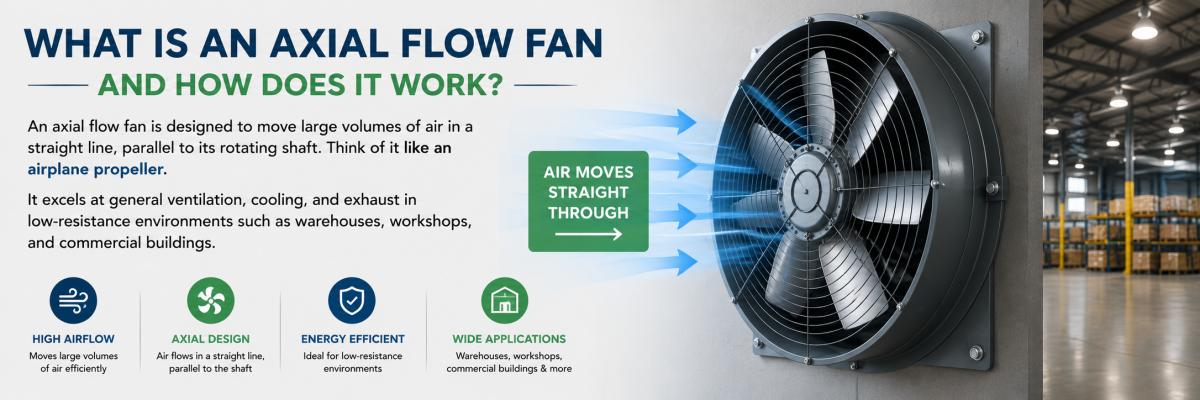
An axial flow fan is designed to move large volumes of air in a straight line, parallel to its rotating shaft.1 Think of it like an airplane propeller. It excels at general ventilation, cooling, and exhaust in low-resistance environments such as warehouses, workshops, and commercial buildings.2
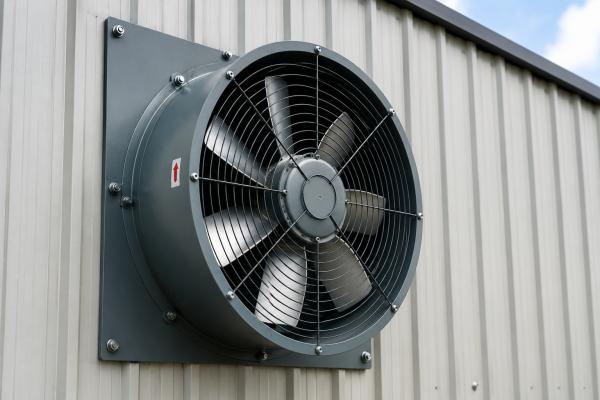
When I talk with buyers, many focus only on the fan's size or airflow number. But that's only part of the story. The real question isn't just "What is an axial fan?" but "Is this the right type of fan for my specific ventilation job?" Understanding how it works and where it works best is the first step. Let's break down what you really need to know before you make a choice. This will help you avoid common mistakes and find a solution that actually performs well in your space.
How Do You Identify the Key Parts of an Axial Fan?
You see an axial fan mounted on a wall, but what are you really looking at? Understanding its components helps you see why it works the way it does.
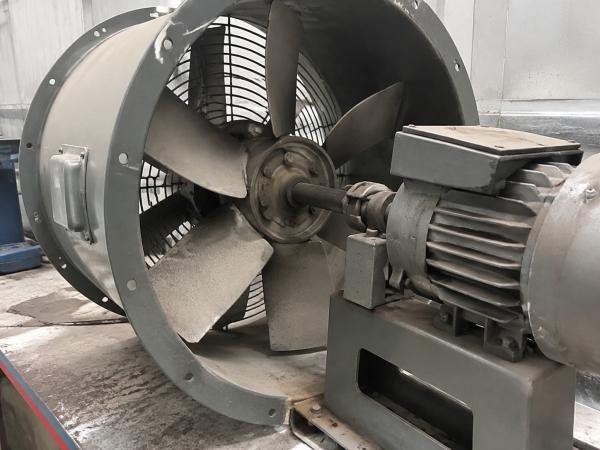
The main parts are the motor, impeller (blades), and a housing or frame.3 These components work together to draw air in and push it straight out. The design is simple, which is why it's so effective for moving large amounts of air with low resistance.
In my years of manufacturing, I've learned that a fan is only as strong as its weakest part. A powerful motor with poorly designed blades won't perform well. A great impeller in a flimsy frame won't last. That's why we look at how these parts function together. Here is a simple breakdown of what each part does and what to consider.
The Core Components
- Motor: This is the engine of the fan. It turns the shaft that the blades are attached to. When talking to a supplier, you'll need to confirm the voltage, phase (single or three-phase), and power (kW or HP) to match your electrical system. A good motor is efficient and durable.
- Impeller (Blades): These are the angled blades that actually move the air. The shape, angle (pitch), and number of blades determine how much air the fan can move (airflow) and at what pressure.4
- Housing or Frame: This structure holds everything together. For wall-mounted exhaust fans, it's often a square panel. For duct fans, it's a cylinder. The housing protects the internal parts and helps direct the airflow.
- Guards: These are the safety grilles on the front and back. They are essential for preventing accidental contact with the rotating blades, a critical safety feature in any industrial or commercial setting.5
| Part | Primary Function | What to Check with a Supplier |
|---|---|---|
| Motor | Powers the rotation of the blades | Voltage, Phase, Power (kW/HP), IP Rating (for dust/water) |
| Impeller/Blades | Pushes or pulls the air | Material (metal, plastic), Blade Angle, Diameter |
| Housing/Frame | Supports the motor and impeller; directs airflow | Material (steel, plastic), Mounting Dimensions |
| Guards | Provides safety protection from rotating blades | Front and back installation, grid spacing |
When Should You Choose an Axial Fan Over Other Types?
You need to move air, but is an axial fan the right tool for the job? Choosing the wrong fan type is a common and costly mistake I see all the time.
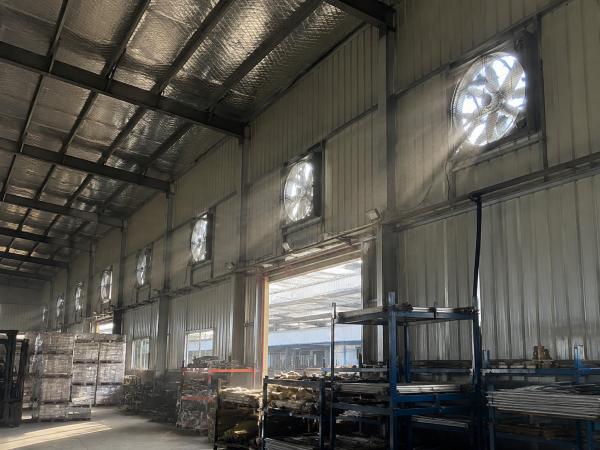
Use an axial fan for high-volume air movement in low-pressure situations.6 It's perfect for general circulation in a warehouse, exhausting heat from a workshop, or supplying fresh air through a short duct.
A customer once called me, frustrated that the axial fan he bought wasn't pulling smoke out of his long, winding kitchen duct system. The problem wasn't the fan's quality; it was the wrong type of fan for the task. His system had high resistance, which axial fans are not built to handle. He needed a centrifugal fan. This is a key distinction. Axial fans are volume movers, not pressure builders. They are great for open spaces or simple, straight-through applications.
Axial Fans vs. Centrifugal Fans
The main alternative is a centrifugal fan (also called a blower). Understanding the difference is crucial for making the right choice.
- Axial Fans: Move air parallel to the fan shaft. They are like a propeller. They handle large volumes of air but can't push against much resistance (static pressure).
- Centrifugal Fans: Pull air into the center of the fan and discharge it at a 90-degree angle. They are like a hamster wheel. They generate much higher pressure and are ideal for systems with ducts, filters, or elbows.7
Here’s a table that breaks it down for typical B2B buyers:
| Feature | Axial Flow Fan | Centrifugal Fan (Blower) |
|---|---|---|
| Airflow Direction | Straight through, parallel to the shaft | Enters at the center, exits at a 90-degree angle |
| Pressure | Low Pressure | High Pressure |
| Air Volume | High Volume | Lower Volume (for the same size) |
| Best For | General ventilation, cooling, simple wall exhaust | Ducted systems, filtering air, moving air against resistance |
| Typical Use | Warehouses, factories, garages, data centers | Kitchen exhaust hoods, HVAC systems, dust collection |
| Noise | Can be louder at the same airflow rate | Generally quieter for high-pressure applications |
So, if you just need to cool down a large room or exhaust stale air directly through a wall, an axial fan is likely your most efficient and cost-effective choice.
Why Does Airflow Volume Alone Not Guarantee Good Ventilation?
Many buyers believe a higher airflow number (CFM or m³/h) always means better performance. This is one of the biggest myths in ventilation. It's like thinking a sports car is great for off-road driving just because it's fast.
Airflow ratings are measured in ideal, zero-resistance conditions.8 In the real world, obstacles like ducts, filters, and louvers create resistance (static pressure). If a fan can't overcome this pressure, its actual airflow will drop significantly.9
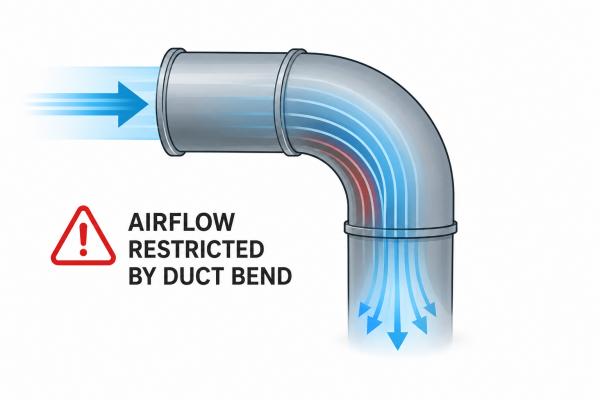
I often get requests from importers asking for a fan with "at least 5,000 CMH." My first question is always: "What is the application and installation environment?" A fan that delivers 5,000 CMH in open air might only deliver 2,000 CMH when connected to a duct with a few bends. The fan is working hard, but it's fighting a battle it was not designed for. The key is to understand static pressure.
Understanding Static Pressure
Think of static pressure as the "pushing power" of a fan.
- Airflow Volume (CFM/CMH): This is the amount of air the fan can move per minute or hour.
- Static Pressure (Pa/InAq): This is the force the fan can generate to push that air through obstacles.
An axial fan is a high-volume, low-pressure device. It can move a lot of air, but it doesn't have much pushing power.
Factors that increase static pressure and reduce an axial fan's performance:
- Ducts: The longer and narrower the duct, the higher the resistance.10
- Bends and Elbows: Each turn in a duct system adds significant resistance.11
- Filters: Air filters, especially dense ones, create a major obstacle for air to pass through.12
- Louvers and Grilles: The shutters or grilles on the intake or outlet add resistance.
- Wind: For an exhaust fan, strong wind blowing against it can create back pressure.
When selecting a fan, you or your contractor must estimate the total static pressure of your system. Then, you can ask a supplier for the fan's performance curve, which shows how much airflow it delivers at different pressure levels. This is the professional way to ensure the fan will actually work as you expect.
What Common Mistakes Should You Avoid When Installing an Axial Fan?
You’ve chosen the right type of fan. Now, you need to install it correctly. A poor installation can ruin the performance of a perfect fan and even create safety hazards.
Common installation mistakes include creating an opening that is too small, not allowing enough clearance around the fan, and connecting it to the wrong voltage. These errors can starve the fan of air, cause motor burnout, or create excessive noise.
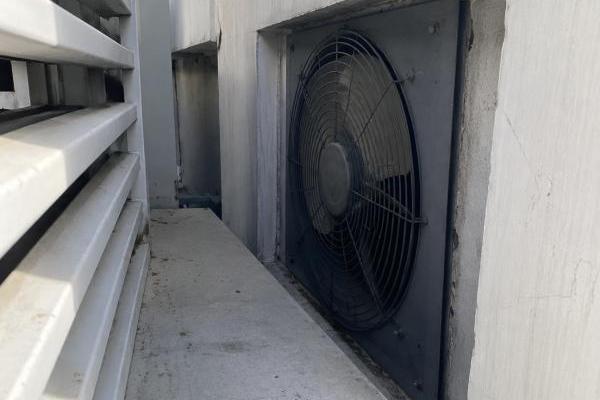
Based on feedback from our clients and distributors over the years, a few installation problems pop up again and again. These issues are easy to avoid with a little planning. Getting the installation right from the start saves you headaches with performance complaints, returns, or rework later on. It's especially critical for contractors and distributors whose reputation depends on a job well done.
Key Installation Checklist
Before you or your team installs an axial fan, run through this simple checklist.
- Correct Opening Size: The wall or panel opening must be at least as large as the fan's blade diameter. If the hole is too small, it will restrict airflow (like trying to breathe through a straw) and increase noise.
- Sufficient Clearance: The fan needs space to breathe. Ensure there are no walls, equipment, or other obstructions too close to the intake or outlet side of the fan. This can create turbulence and reduce efficiency. A good rule of thumb is to have at least 1.5 times the fan diameter in clear space.
- Secure Mounting: The fan, especially a large industrial model, creates vibration. It must be securely bolted to a solid structure. A loose fan is noisy and dangerous.
- Correct Electrical Connection: This is a big one. Always double-check that the fan's voltage and phase match your power supply. Connecting a 220V fan to a 380V supply will instantly burn out the motor. This is a frequent and completely avoidable mistake.
- Weather Protection: If the fan is installed outdoors or exposed to the elements, ensure the motor has a suitable IP (Ingress Protection) rating to protect against water and dust. For exhaust fans, a rain hood or weather cowl is often necessary.
By paying attention to these simple details, you ensure the fan delivers the performance you paid for and operates safely for years.
Conclusion
Choosing the right axial fan means matching its low-pressure, high-volume design to your space. Always check your site's resistance and technical needs with your supplier before making a purchase.
"Axial fan design", https://en.wikipedia.org/wiki/Axial_fan_design. A standard reference definition describes axial-flow fans as devices in which air moves generally parallel to the axis of rotation, supporting the article's description of the basic airflow path; this does not by itself verify the performance of any specific fan model. Evidence role: definition; source type: encyclopedia. Supports: A neutral source should define axial fans as fans that move air along the axis of rotation and commonly serve high-volume airflow applications.. Scope note: The source supports the general definition, not the rated airflow of a particular product. ↩
"AE12/AE020: Fans For Greenhouses - Ask IFAS", https://ask.ifas.ufl.edu/publication/AE020. Government fan-system guidance characterizes axial fans as appropriate for relatively high airflow and low-pressure ventilation duties, which contextualizes their use in warehouses and similar spaces; actual suitability still depends on the installed system resistance. Evidence role: general_support; source type: government. Supports: A fan-system guide should support that axial fans are commonly used for large airflow at relatively low static pressure in ventilation and cooling applications.. Scope note: The source would support the general application category rather than a site-specific design decision. ↩
"Fan Impeller - an overview | ScienceDirect Topics", https://www.sciencedirect.com/topics/engineering/fan-impeller. Engineering teaching materials commonly describe fan assemblies in terms of an impeller, a driving motor or shaft, and a casing or housing, supporting the article's component breakdown; terminology may vary among fan types and standards. Evidence role: definition; source type: education. Supports: An educational engineering source should identify the typical parts of a fan assembly, including the impeller, drive or motor, and casing or housing.. Scope note: The support is definitional and may not list every accessory used in industrial fan packages. ↩
"The Effect of Tip End-Blade Geometry on the Axial Fans Performance", https://www.academia.edu/49250944/The_Effect_of_Tip_End_Blade_Geometry_on_the_Axial_Fans_Performance. Studies of axial-fan aerodynamics show that blade pitch, solidity, and blade geometry affect flow rate and pressure rise, supporting the article's explanation of how impeller design influences performance; the magnitude of the effect is design-specific. Evidence role: mechanism; source type: paper. Supports: A research paper should explain that blade geometry and pitch influence aerodynamic loading, flow rate, and pressure rise in axial fans.. Scope note: Research support is mechanistic and may be based on particular fan geometries rather than all commercial axial fans. ↩
"Defining Acceptable Guarding of Fan Blades", http://www.osha.gov/enforcement/directives/std-01-12-001. Occupational safety guidance on machine guarding requires or recommends guarding exposed rotating parts to prevent worker contact, supporting the article's statement that fan guards serve a critical protective function; exact guard specifications depend on jurisdiction and installation. Evidence role: expert_consensus; source type: government. Supports: An occupational safety authority should support that rotating machine parts, including fan blades, require guarding to prevent contact injuries.. Scope note: The source supports the safety principle, while local codes determine the precise compliance requirements. ↩
"Axial Flow Fan - an overview | ScienceDirect Topics", https://www.sciencedirect.com/topics/engineering/axial-flow-fan. Fan-system guidance classifies axial fans as generally suited to high-flow, low-pressure duties, supporting the article's selection rule; fan curves must still be checked for the specific operating point. Evidence role: general_support; source type: government. Supports: A fan-system reference should state that axial fans generally deliver high flow at comparatively low static pressure.. Scope note: The source gives a general category distinction and does not replace model-specific performance data. ↩
"Fans and Blowers | OSU Energy Efficiency Center", https://eec.oregonstate.edu/fans-and-blowers. Authoritative fan-system references distinguish centrifugal fans as better suited than axial fans for higher-pressure applications such as ductwork and filtration, supporting the article's comparison; the distinction is typical rather than absolute because individual fan designs vary. Evidence role: general_support; source type: government. Supports: A fan-system source should explain that centrifugal fans are commonly used where higher static pressure is needed, such as ducted systems or systems with resistance.. Scope note: The source supports the general comparison, not every possible axial or centrifugal fan configuration. ↩
"PTCS External Static Pressure – CFM Manufacturer ...", https://www.bpa.gov/-/media/Aep/energy-efficiency/residential/residential-ptcs-essentials/ptcs-esp-cfm-lookup-tables-final.pdf. Fan performance standards and rating methods report airflow as a function of static pressure and include free-air or zero-static-pressure conditions, supporting the article's caution about headline airflow ratings; a specific product datasheet is needed to know how a given rating was obtained. Evidence role: definition; source type: institution. Supports: A standards or testing source should explain that fan performance can be reported at different static pressures, including free-air or zero-static-pressure conditions.. Scope note: The source supports how ratings can be expressed, not whether every manufacturer uses the same headline condition. ↩
"Static pressure and fan curves : r/HVAC - Reddit", https://www.reddit.com/r/HVAC/comments/2jn7fg/static_pressure_and_fan_curves/. Fan-system engineering guidance explains that delivered flow is determined by the fan performance curve and the system resistance curve, so higher static pressure generally reduces airflow, supporting the article's warning; the size of the reduction depends on the specific curves. Evidence role: mechanism; source type: government. Supports: A fan-system reference should explain that operating airflow is determined by the intersection of the fan curve and system resistance curve, and that increased resistance reduces flow.. Scope note: The source supports the mechanism but not the article's illustrative numerical examples. ↩
"[PDF] Compression Effects on Pressure Loss in Flexible HVAC Ducts - OSTI", https://www.osti.gov/servlets/purl/836654. HVAC duct-design references describe friction losses as increasing with duct length and with reduced hydraulic diameter for a given airflow, supporting the article's statement about long, narrow ducts; exact losses require calculation from flow rate, roughness, and fittings. Evidence role: mechanism; source type: education. Supports: An HVAC or fluid mechanics source should support that pressure loss in ducts rises with length and is greater in smaller ducts at comparable flow conditions.. Scope note: The source provides the general pressure-loss relationship rather than a project-specific pressure calculation. ↩
"Pressure Losses across Multiple Fittings in Ventilation Ducts", https://pmc.ncbi.nlm.nih.gov/articles/PMC3872430/. Duct-design references treat elbows and bends as fittings that add pressure-loss coefficients to the total system resistance, supporting the article's warning that turns reduce fan performance; the term 'significant' depends on bend geometry and airflow velocity. Evidence role: mechanism; source type: education. Supports: An HVAC engineering source should explain that elbows and bends introduce minor losses or fitting losses that increase total system resistance.. Scope note: The source supports the existence of added resistance, while the magnitude depends on the specific fitting design. ↩
"[PDF] Indoor airPLUS Technical Bulletin Filtration - EPA", https://www.epa.gov/sites/default/files/2020-06/documents/2019.11_tech_bulletin_filtration.pdf. HVAC filtration guidance notes that air filters impose pressure drop and that filter efficiency and loading can increase resistance to airflow, supporting the article's statement that filters can reduce fan delivery; pressure drop varies by filter model, face velocity, and dust loading. Evidence role: mechanism; source type: government. Supports: A government or HVAC source should support that filters add pressure drop and that filter characteristics influence airflow resistance.. Scope note: The source supports the mechanism, not the pressure drop of any particular filter installation. ↩