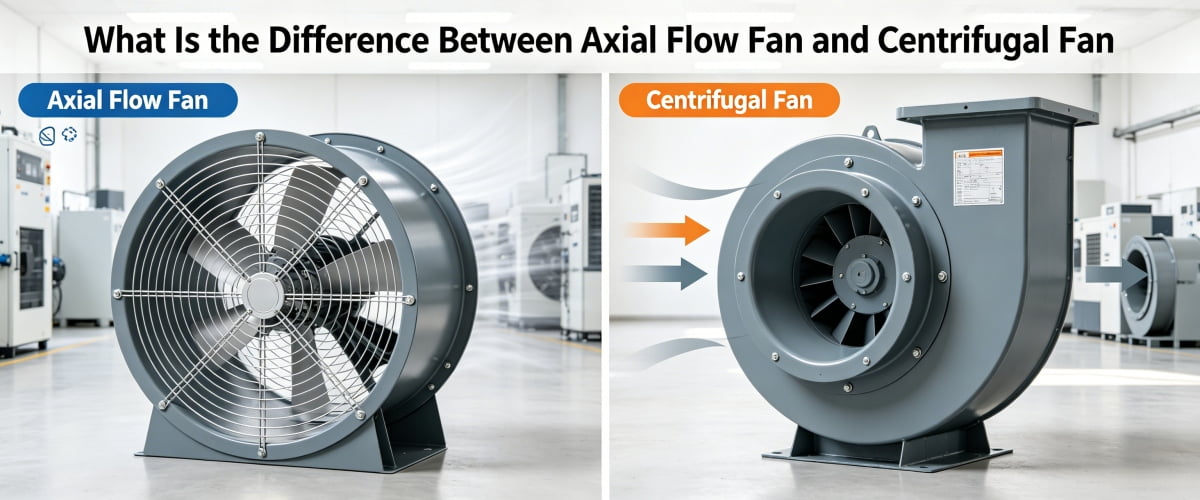
Industrial buyers often feel confused when choosing between axial and centrifugal fans for factory ventilation. Many people think it’s just a matter of power or fan size, but making the wrong choice can cause airflow problems and costly rework1.
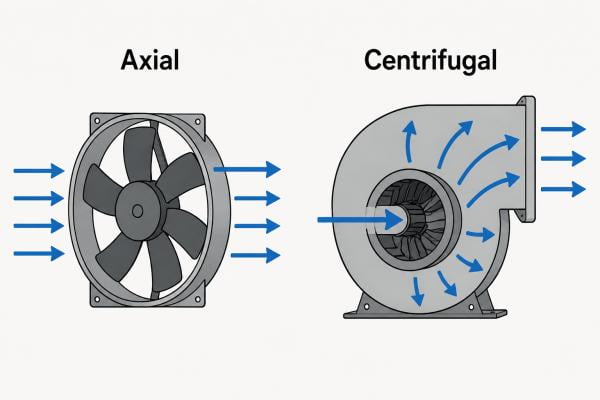
Axial flow fans and centrifugal fans serve different application needs. Axial fans move air in a straight line2, making them ideal for large, open spaces with low resistance3. Centrifugal fans can create higher pressures4, and are better for ducted or high-resistance systems5.
I have seen customers—whether importers, warehouse buyers, or project contractors—ask me: “If the power and airflow are about the same, can I just swap between the two types?” I have also fixed projects where fans were mismatched, leading to loud noise, poor airflow, and complaints from end users. Based on many years of direct case experience in factories and on engineering projects, I want to break down the key decision points so you don’t fall into these traps yourself.
Axial Flow Fan: When Is Straight-Through Airflow the Key?
Many users believe a more powerful fan automatically means better airflow. However, just installing a “bigger” axial fan does not guarantee good results in every situation6.
Axial flow fans are best for spaces where air needs to move in a straight line with little resistance. They are great for cooling large open areas, walls, or laying ventilation directly through short ducts.
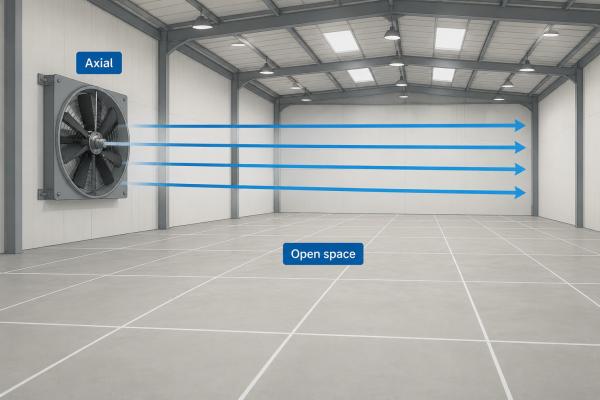
Most of the warehouse and factory managers I have helped choose fans first request: “I need strong wind for a big open space to quickly reduce temperature.” Here is where axial fans work best. The fan blades push air in the direction of the shaft, so air flows straight out, creating a cooling breeze across a wide area. If the walls or roof are equipped with air holes or simple louver windows, the air can exit easily, and pressure loss is small7.
But I’ve seen projects where customers thought “bigger is better” and put huge axial fans in long duct systems or areas full of obstacles. The result was lots of vibration and noise, little real airflow at the outlet, and a waste of energy. This tells us: if your installation site involves complex ductwork or needs to overcome high pressure, the axial type will struggle8.
Let’s break down the typical right and wrong applications:
| Application Type | Axial Fan = Good Choice? | Real-World Example |
|---|---|---|
| Open warehouse floor | Yes | Large factory cooling, direct wall-to-wall airflow |
| Garage/vent through thin wall | Yes | Direct exhaust from warehouse/parking lot through the wall |
| Long ductwork or bending pipe | No | Air cannot overcome resistance and stagnates in the pipes |
| Pressurizing confined spaces | No | Axial fan air pressure is not strong enough for sealed rooms |
Engineers I have worked with often say: “If airflow has to fight a long or twisted duct, then axial is not your friend.” Use them where air flows naturally and you want maximum volume in minimum obstruction.
Centrifugal Fan: Why Does Fan Pressure Matter?
It can be tempting to use centrifugal fans everywhere “just to be safe,” but that is not cost-effective or necessary for many open spaces.
Centrifugal fans are preferred when you need higher pressure to push air through pipes, filters, or other resistance-heavy layouts. This is common in kitchen exhaust, central ventilation systems, or projects with long duct networks.
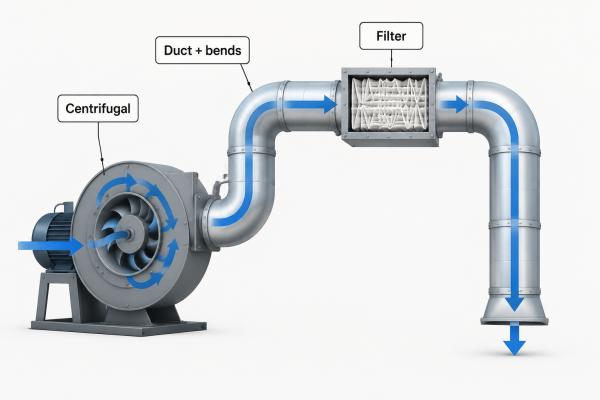
I recall supporting a commercial kitchen project where the contractor installed axial fans for smoke exhaust. The fans worked fine during a dry trial, but when real cooking was happening and filters clogged, the airflow dropped dramatically, and backflow filled the kitchen with smoke. After site inspection, we replaced the axials with centrifugal fans that could maintain airflow even under pressure.
Centrifugal fans pull air into the center, then force it out radially using centrifugal force9. This creates stronger pressure and lets air continue moving through twists, turns, and filters. They also isolate the motor outside of the airflow, which helps with high temperature or grease-laden air.
Let’s summarize using a simple table:
| Application Type | Centrifugal Fan Needed? | Case Study Example |
|---|---|---|
| Duct with multiple bends | Yes | Factory dust removal with pipe heat recovery |
| High-resistance filter systems | Yes | Kitchen or chemical lab exhaust with multiple stages |
| Simple open wall exhaust | No | Air cannot move freely, waste of pressure, unneeded cost |
| Tight noise/vibration limits | Yes | Centrifugal fans can be built with stronger vibration isolation |
Project engineers often ask, “How much pressure must my fan handle?” It is rarely a simple number; you must add up resistance from ducts, vents, filters, and any other system details10. Centrifugal fans can handle far more, but efficient selection saves money and avoids overkill.
How the Wrong Fan Choice Causes Real Problems
I have seen many situations where a fan looked fine on paper, but failed in practice. The source of the problem was not the specifications but missing out on system resistance, installation, or airflow direction needs.
A typical scenario: a warehouse operator contacts me after recent renovations because the new ventilation system is extremely loud and still stuffy even with high-rated fans. When I ask for layout plans, it turns out the contractor used axial fans in a long spiral duct. The fans are working hard, but most of the airflow is lost to leaks or recirculates internally, leading to noise and poor performance.
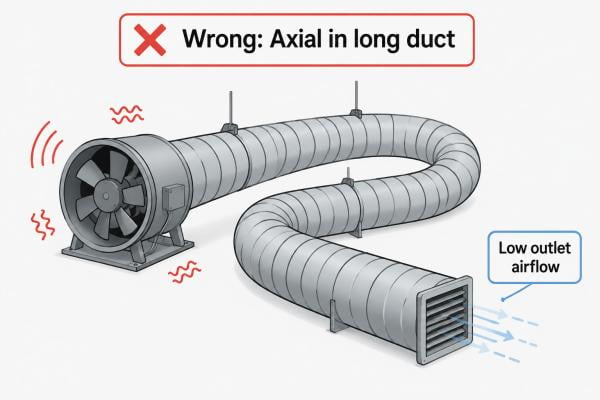
This kind of mismatch causes:
- Weak airflow at outlets or grills, especially far from the fan.
- Fan motor runs hot or fails early.11
- Complaints about noise and vibration, more common with axial fans under pressure.
- Higher operating costs without better performance.
In another real-world project, a customer insisted on a centrifugal fan to “make sure we get enough air” for a small, direct roof exhaust. They ended up with an expensive, heavy fan that was hard to install, and airflow was so powerful it caused drafts and whistling. Smaller axial fans would have worked better, cost less, and been easier to mount.
Here’s what I remind buyers:
| Risk/Issue | How the Wrong Fan Type Makes it Worse |
|---|---|
| Poor airflow in distant/ducted points | Axial fans lack pressure; little air reaches the outlet |
| Overheating or burnt out motors | Both types, if run out of spec, can overheat |
| Installation headaches | Larger centrifugal fans are heavier/harder to mount |
| After-sales complaints: noise, cost | Noise: axial in duct; cost: unnecessary centrifugal fan use |
I have found that talking through your actual site conditions and air path—rather than just fan “size”—prevents 90% of these headaches12.
How to Decide: Real-World Questions to Ask Before You Choose
With so many models and numbers out there, it’s easy to get caught in “tech specs only” thinking. In all my years helping customers pick the right fans, I find a few simple site questions make the biggest difference:
- How long is the air path? Is most of it open or closed?
- How many bends, filters, or obstructions are in the system?
- Will installation space allow for the larger size/shape of a centrifugal fan if needed?
- Is low noise important, or can higher sound be tolerated?
- Will vents have to push air up, down, or level?
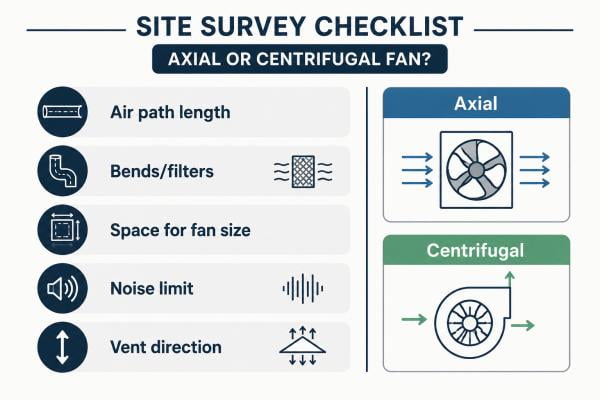
Here is a practical comparison for use on real projects:
| Question | Choose Axial Flow Fan | Choose Centrifugal Fan |
|---|---|---|
| Installing in a large, open, flat space? | Usually YES | Rarely |
| Ducted system with bends or many outlets? | NO, not recommended | YES |
| High-pressure/VOCs/grease in airflow? | Not suitable | Recommended |
| Low budget/quick swap needed? | Good fit | Can be overkill |
I often say, “There is no best fan, only the best fit for your project’s real needs.” If you’re unsure, asking your supplier or a project engineer for case studies from similar sites often gives much more helpful answers than just looking at catalogs.
Conclusion
Choosing between axial and centrifugal fans is all about matching airflow needs, pressure, and actual site conditions—never just labels or size.
"[PDF] DOE-HDBK-1169-2003; DOE Handbook Nuclear Air Cleaning ...", https://www.energy.gov/sites/default/files/2026-05/DOE-HDBK-1169-2003_Chapter-5.pdf. Fan-selection guidance from an engineering or government source can support that incorrect matching of fan type to system requirements can reduce delivered airflow and require corrective redesign or replacement; this is contextual support rather than documentation of the article’s specific projects. Evidence role: general_support; source type: government. Supports: Selecting the wrong fan type can lead to airflow problems and costly rework.. Scope note: The source will likely support the engineering principle, not the article author's individual rework cases. ↩
"Axial fan design - Wikipedia", https://en.wikipedia.org/wiki/Axial_fan_design. A technical reference on fan types can verify that axial-flow fans move air generally parallel to the fan shaft or axis, supporting the definition used here. Evidence role: definition; source type: encyclopedia. Supports: Axial fans move air in a straight line along the fan axis.. ↩
"[PDF] Vane-Axial Or Propeller Fans - CDC Stacks", https://stacks.cdc.gov/view/cdc/8793/cdc_8793_DS1.pdf?download-document-submit=Download. Fan engineering guidance can support that axial fans are commonly used where high volume flow is needed at relatively low static pressure, such as open or low-resistance ventilation applications; it does not by itself prove suitability for every open-space installation. Evidence role: expert_consensus; source type: institution. Supports: Axial fans are generally suited to large, open, low-resistance ventilation applications.. Scope note: Suitability still depends on calculated airflow, pressure losses, installation geometry, and local codes. ↩
"Fans with the most static pressure for the cost, space, and noise level", https://www.reddit.com/r/watercooling/comments/17t0kdd/fans_with_the_most_static_pressure_for_the_cost/. A neutral engineering source can support that centrifugal fans are designed to generate higher static pressures than typical axial fans, which is why they are often selected for systems with greater flow resistance. Evidence role: mechanism; source type: education. Supports: Centrifugal fans can create higher pressures than axial fans in typical ventilation comparisons.. Scope note: Actual pressure capability varies by fan design, wheel type, size, speed, and operating point. ↩
"Pressure Losses across Multiple Fittings in Ventilation Ducts - PMC", https://pmc.ncbi.nlm.nih.gov/articles/PMC3872430/. HVAC or ventilation design guidance can support that centrifugal fans are commonly selected for ducted systems because they can overcome pressure losses from ductwork and fittings; this is a general design principle rather than a project-specific sizing rule. Evidence role: expert_consensus; source type: government. Supports: Centrifugal fans are better suited than axial fans for ducted or high-resistance systems.. Scope note: A centrifugal fan still must be selected from its performance curve for the calculated system pressure and flow. ↩
"[PDF] appendix 7-b. system curve derivation for furnace fans", https://www1.eere.energy.gov/buildings/appliance_standards/pdfs/ff_prelim_app_07_b_system_curve_2012_06_22.pdf. Fan-system guidance can support that delivered airflow depends on the interaction between a fan performance curve and the system resistance curve, so increasing fan size alone may not solve airflow problems. Evidence role: mechanism; source type: government. Supports: Installing a larger axial fan does not necessarily improve results if system resistance or operating point is unsuitable.. Scope note: The cited source may explain the general fan-system relationship rather than discuss axial fans specifically. ↩
"Pressure Losses across Multiple Fittings in Ventilation Ducts - PMC", https://pmc.ncbi.nlm.nih.gov/articles/PMC3872430/. Ventilation design references can support that short, direct air paths with few fittings or obstructions generally have lower pressure losses than long duct runs with bends, filters, or restrictions. Evidence role: mechanism; source type: education. Supports: Pressure loss is small when air exits through simple openings or short, low-obstruction paths.. Scope note: The exact pressure loss depends on dimensions, velocities, openings, louvers, and installation details. ↩
"[PDF] G95-1242 Ventilation Fans: Performance - UNL Digital Commons", https://digitalcommons.unl.edu/cgi/viewcontent.cgi?article=1595&context=extensionhist. A fan-selection source can support that axial fans generally provide high flow at relatively low static pressure and may be unsuitable where long ducts, bends, or other restrictions create high pressure losses. Evidence role: expert_consensus; source type: institution. Supports: Axial fans can struggle in complex ductwork or high-pressure applications.. Scope note: Some specialized axial fans can operate at higher pressures, so the statement is most accurate for typical axial ventilation fans. ↩
"Centrifugal pump - Wikipedia", https://en.wikipedia.org/wiki/Centrifugal_pump. A technical reference can verify that centrifugal fans draw air into the impeller inlet and discharge it radially after imparting energy through the rotating wheel. Evidence role: definition; source type: encyclopedia. Supports: Centrifugal fans pull air into the center and discharge it radially.. ↩
"Pressure Losses across Multiple Fittings in Ventilation Ducts - PMC", https://pmc.ncbi.nlm.nih.gov/articles/PMC3872430/. Ventilation design guidance can support that total system resistance or static pressure is calculated by accounting for losses from duct lengths, fittings, vents, filters, and related components. Evidence role: mechanism; source type: government. Supports: Fan pressure requirements must account for resistance from ducts, vents, filters, and other system components.. Scope note: A complete calculation may also require airflow rate, duct roughness, air density, fitting coefficients, and equipment-specific data. ↩
"[PDF] Improving Motor and Drive System Performance - eere.energy.gov", https://www1.eere.energy.gov/manufacturing/tech_assistance/pdfs/motor.pdf. A motor or fan-system reliability source can support that operating fans outside their intended performance range can increase motor load, heat generation, or stress, contributing to overheating and premature failure. Evidence role: mechanism; source type: government. Supports: A misapplied fan can cause the motor to run hot or fail prematurely.. Scope note: Motor overheating depends on motor design, protection, load curve, ventilation, ambient temperature, and maintenance condition. ↩
"[PDF] ANSI/AMCA Standard 99-25", https://www.amca.org/assets/resources/public/publish/ansi-amca-99-25-standards-handbook-5.1.25.pdf. Fan-selection guidance can support the qualitative point that site conditions, airflow path, and system resistance are central to proper fan selection; it would not substantiate the specific “90%” figure unless a source with that statistic is found. Evidence role: general_support; source type: institution. Supports: Considering actual site conditions and air path is more important than relying only on fan size when preventing selection problems.. Scope note: The numerical percentage appears anecdotal and should either be sourced directly or softened if no empirical basis exists. ↩